Nobody searches for "DevOps consulting services" out of curiosity. There is almost always a trigger: a release that should have taken a day and took two weeks. A Kubernetes or cloud migration that no one on the team has done at this scale. A SOC 2 or HIPAA deadline approaching on infrastructure that was never built with audits in mind. A senior DevOps hire that has been open for months while the infrastructure backlog keeps growing.
DevOps consulting services exist for exactly this moment. A consultant brings specific expertise and an outside perspective to a defined problem, builds the roadmap, helps implement it, and leaves your team better equipped than before. The goal is not to replace your engineers, and it is not to create a long-term dependency.
The same pattern shows up across engagements: specific challenges go in, a structured assess → design → implement → enable cycle runs, and specific outcomes come out the other side.
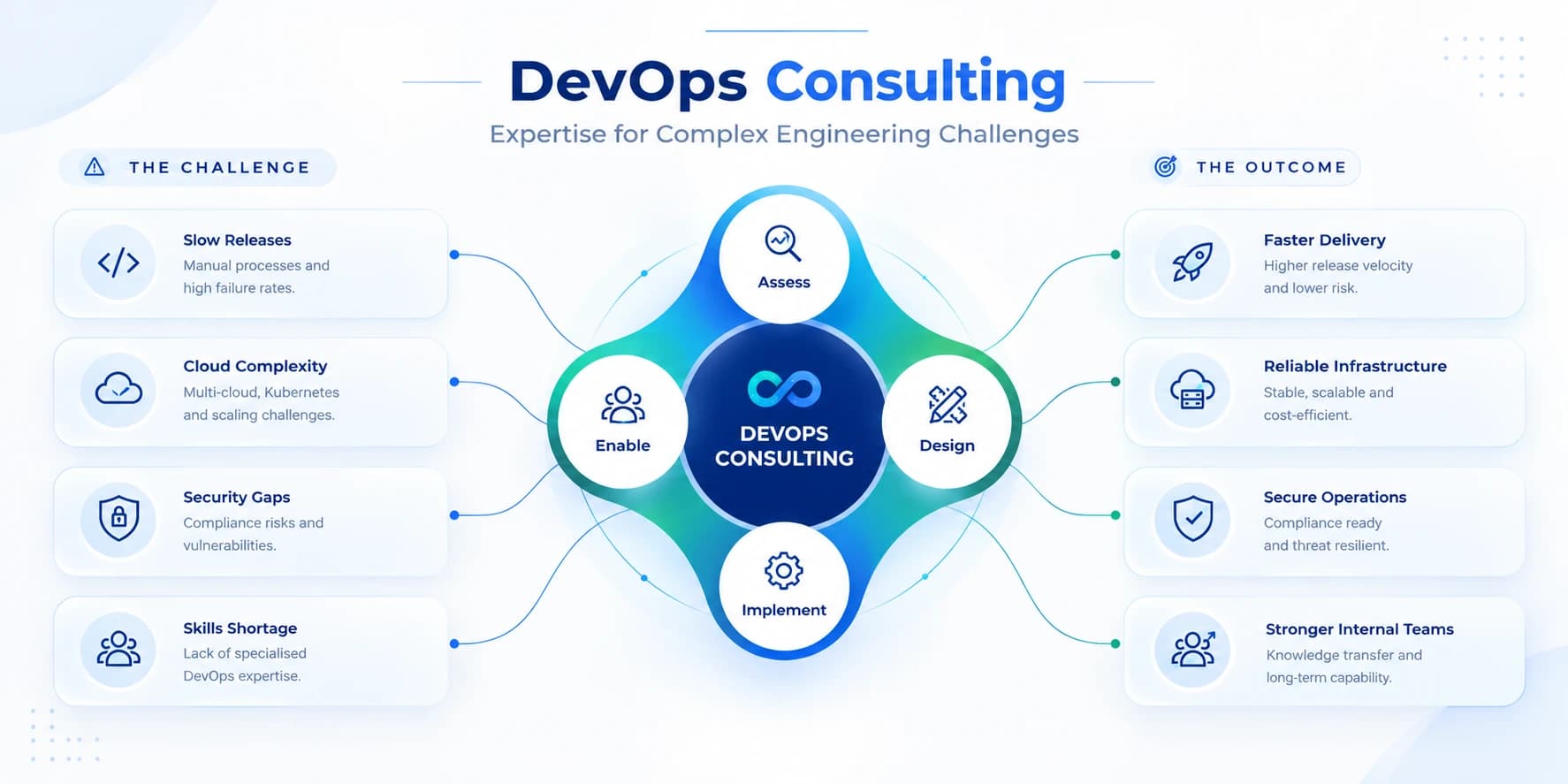
This guide explains what a consulting engagement should actually include, how it differs from managed services and hiring, what affects cost, and how to evaluate a partner before you sign anything.
Short on time? Skip ahead to our free DevOps assessment.
Book a Free DevOps AssessmentWhat Are DevOps Consulting Services?
DevOps consulting services are advisory and implementation engagements in which an external specialist assesses your current development and operations practices, designs a target approach, and helps implement it. They are typically time-boxed: assessment, design, implementation, enablement, handoff. They are not an ongoing operational commitment. You may also see this described as DevOps advisory services, DevOps professional services, or consulting for DevOps — the labels vary, but the shape is the same: a defined problem, a defined outcome, and an end point.
DevOps Consulting vs DevOps Managed Services
This is the distinction most providers blur, because ongoing services bill for longer. Here it is plainly.
| DevOps Consulting | DevOps Managed Services | |
|---|---|---|
| Engagement shape | Time-boxed: assess → design → implement → hand off | Ongoing: continuous operational ownership |
| Who runs things afterwards | Your internal team, using what was built | The provider, continuously |
| Best for | A specific initiative: migration, CI/CD overhaul, DevSecOps adoption, platform redesign | Day-to-day operation of infrastructure and pipelines without a large in-house team |
| What you're buying | Expertise, a roadmap and hands-on implementation | Expertise and continuous execution |
Many companies use both in sequence: consulting to design and build the foundation, then either their own team or a managed arrangement to run it. If you mainly need ongoing operational coverage, read our guide to DevOps Managed Services.
DevOps Consultant vs DevOps Engineer
A DevOps engineer works inside your team, usually permanently, with deep knowledge of your product. A DevOps consultant is engaged externally for a defined initiative and brings broader cross-client experience to a narrower scope. The two are complementary: consultants often design and build, then your engineers own and extend.
When Should You Hire a DevOps Consultant?
A good consulting partner will tell you when consulting is the wrong answer. Use this to self-assess.
Consulting Is Likely a Good Fit If
- You have a specific, scoped initiative: a migration, CI/CD redesign, Kubernetes adoption, or security and compliance readiness.
- Your team can run things day to day, but lacks the expertise for this particular initiative.
- You want to build internal capability, not create dependency on an outside team.
- You need a technically credible second opinion before committing budget to a direction.
Managed Services or Hiring Is Probably Better If
- You need ongoing daily coverage, such as 24/7 incident response or continuous infrastructure management.
- Your gap is headcount for recurring work, not expertise.
- Nobody internally can receive a handoff and maintain what is built.
What This Looks Like in Practice
- The single point of failure: a 15-person engineering team outgrows manual deployment just as its release cadence doubles. Only one engineer fully understands the deploy process, and the risk goes unspoken until that person is on leave during an incident. A consultant can document, automate, and spread that knowledge across the team.
- The compliance deadline: a company preparing for a SOC 2 audit finds that access controls, secrets management and audit logging were never designed for compliance. Retrofitting them under deadline pressure costs far more than building them in from the start.
- The monolith pipeline: a team moving to microservices discovers that a pipeline built for a monolith cannot coordinate a dozen independently deployed services, and nobody on the team has designed a multi-service pipeline before.
Selling a consulting project into a problem that needs full-time operational coverage leaves everyone unhappy three months later. In each case above, the gap is specific, the stakes are high, and the expertise does not need to exist permanently on the team.
Recognise your situation? Tell us what's blocking you and we'll tell you honestly whether consulting, managed services or hiring is the better route.
Talk to a DevOps ConsultantWhat Do DevOps Consulting Services and Solutions Include?
Not a list of tools, but the outcomes and deliverables an engagement should produce.
| Service area | Problem it solves | What you should receive |
|---|---|---|
| DevOps assessment & roadmap | Unclear current state, competing priorities | Written findings, risk list, prioritised roadmap (not just a maturity score) |
| CI/CD pipeline design | Slow, manual or unreliable releases | Redesigned pipelines with documented reasoning your team can extend |
| Infrastructure as Code adoption | Manual, undocumented provisioning | Version-controlled, reviewable infrastructure (Terraform, Pulumi or equivalent) |
| Observability setup | Problems found by customers first | Monitoring, logging and alerting built around what matters to your application |
| DevSecOps consulting | Security and compliance bolted on late | Security checks inside the pipeline, mapped to SOC 2, HIPAA, ISO 27001 or similar |
| Cloud architecture & cost review | Rising, unexplained cloud spend | Right-sizing and architecture recommendations, not a one-time report that goes stale |
| Kubernetes & cloud-native consulting | Container adoption without the experience to evaluate the right Kubernetes tools | Reference architecture, migration plan, operational runbooks |
| Team enablement | Knowledge locked with outsiders | Documentation, pairing sessions, training and runbooks |
The last row is the one most consulting pages skip, and the one that decides whether the engagement was worth it six months later. If the output is a black box your team is afraid to touch, the engagement failed, however good the technology.
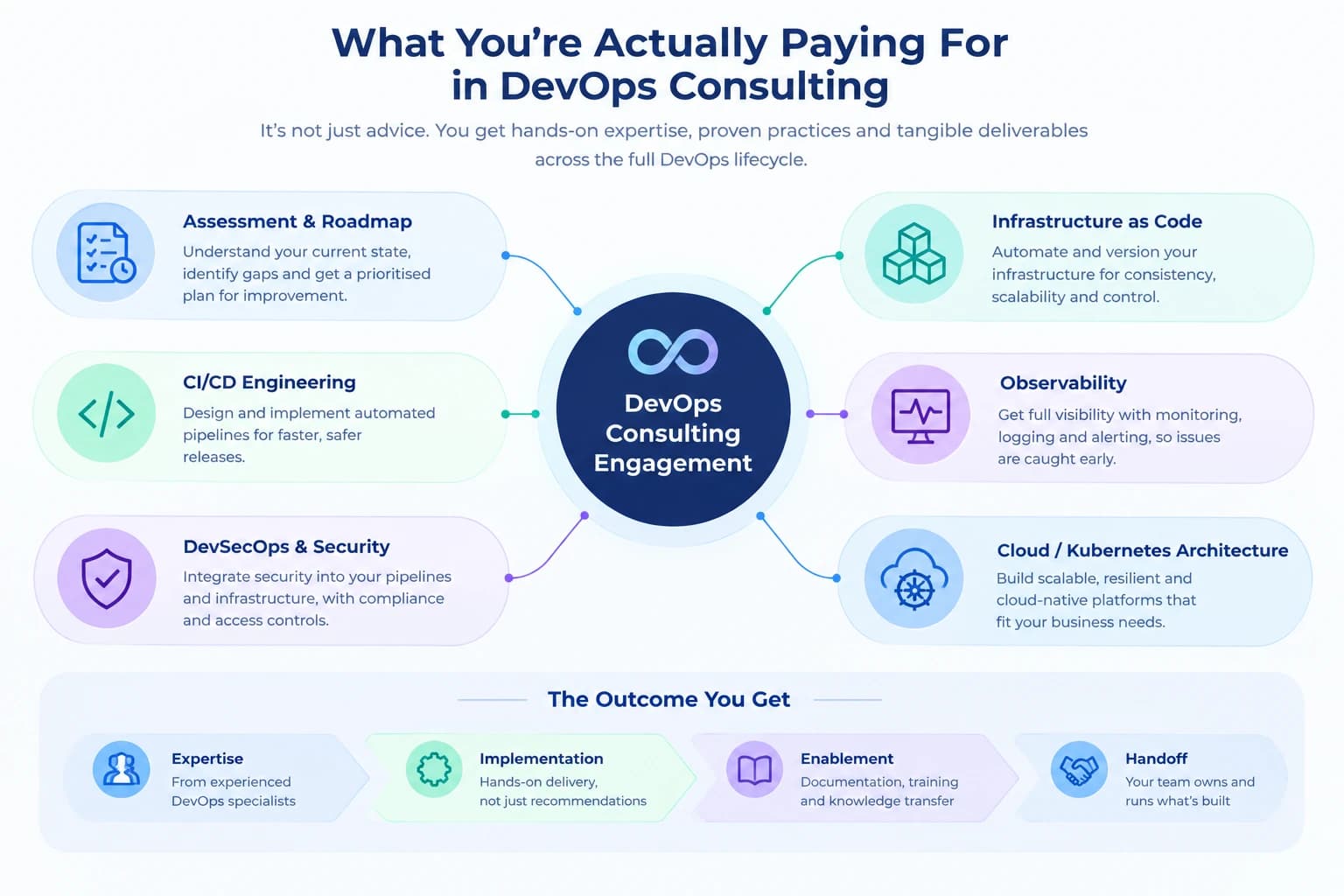
Put together, a DevOps consulting engagement isn't advice in isolation — it's expertise, hands-on implementation, enablement and a defined handoff across the full lifecycle.
Azure DevOps, AWS and GCP: Does Your Cloud Change the Consulting?
DevOps consulting should be platform-aware but not platform-biased. The right consultant evaluates your actual cloud rather than steering you to whichever one they prefer to bill for. One point of confusion worth clearing up: people searching for an "Azure DevOps consultant" mean one of two things.
- Azure DevOps (the product): Microsoft's platform for work tracking, repositories, pipelines, artifacts and test management. Consulting here covers pipeline design, migrations from other CI/CD tools, branch and release policies, and governance.
- DevOps on Azure (the platform): applying DevOps practices to workloads running on Azure, such as AKS, infrastructure as code, Azure landing zones, and identity and access management.
A good consultant clarifies which one you need in the first conversation. The same applies to AWS and GCP: the question is whether you need help with a specific toolchain, with your cloud architecture, or both.
DevOps Consulting vs In-House Team vs Managed Services
Most comparisons stop at "in-house vs outsourced". There are really three options, and they solve different problems.
| Factor | In-house team | DevOps consulting | Managed services |
|---|---|---|---|
| Best for | Ongoing ownership with full product context | A defined initiative needing specialist expertise | Ongoing operations without a large internal team |
| Time to start | Months (hiring, onboarding) | Weeks | Weeks |
| Expertise breadth | What you have hired | Broad, engagement-specific | Broad, provider-wide |
| Cost shape | Fixed salary overhead | Project-based, ends with scope | Ongoing retainer |
| When it ends | Permanent | Your team owns and runs what was built | Provider keeps running it |
| Main risk | Slow to course-correct | Contained to project scope | Dependency on provider continuity |
None of these is universally better. A company in its first year of scaling often needs managed services because there is no team yet to hand anything off to. A company with a capable platform team that has never done one specific migration usually needs consulting for that initiative alone. Choose based on your team structure, not on what a sales call recommends.
How a DevOps Consulting Engagement Works, Step by Step
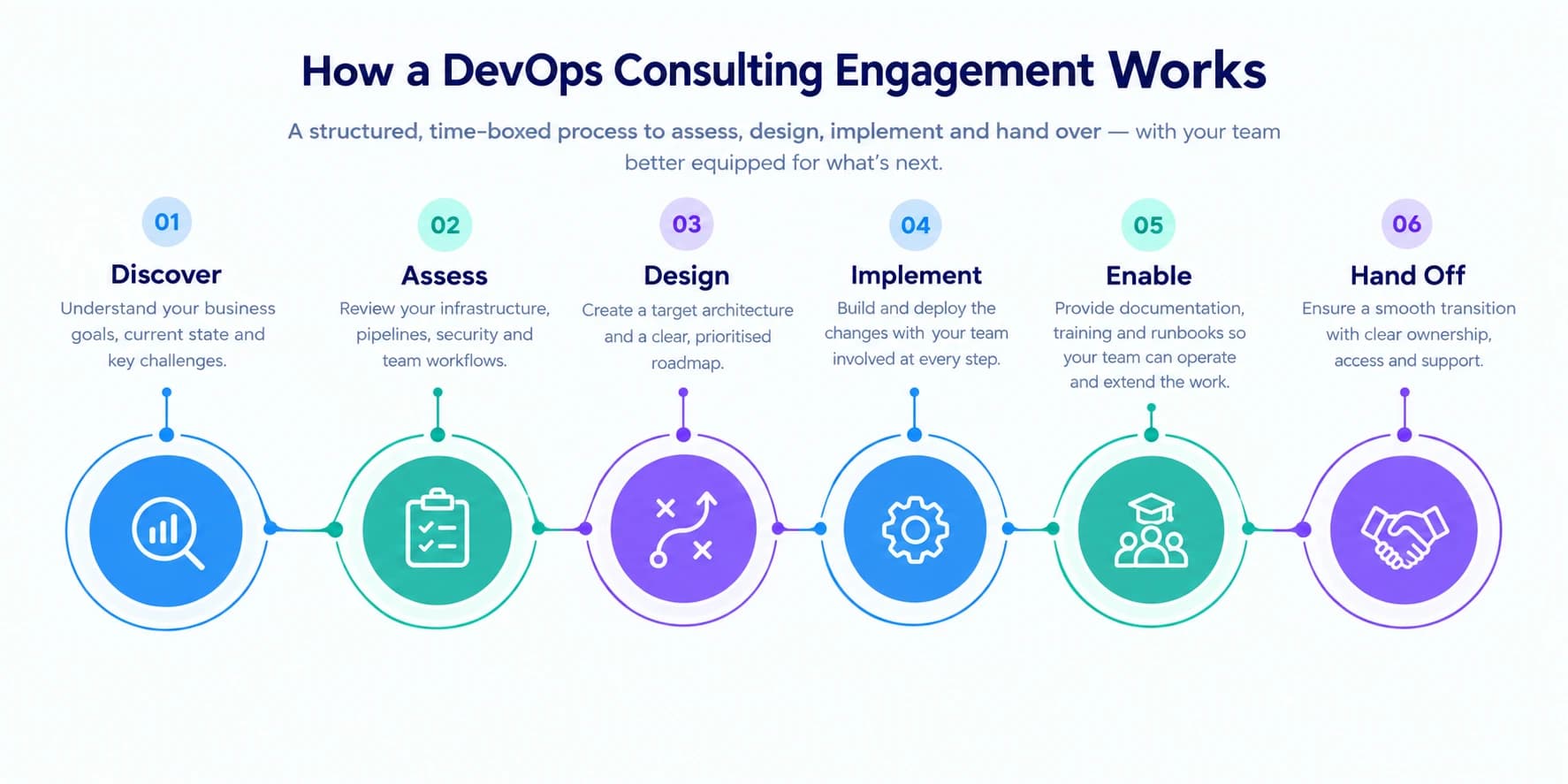
Discover → Assess → Design → Implement → Enable → Hand off.
| Stage | What happens | Output |
|---|---|---|
| 1. Discover | Understand the business goal behind the request, not just the technical ask. | Agreed goals and success criteria |
| 2. Assess | Review infrastructure, pipelines, security posture and team workflows against the goal. | Findings and risk list |
| 3. Design | Produce a target architecture and a sequenced plan: what changes first, what depends on what, where the risk is. | Roadmap and architecture |
| 4. Implement | Build the agreed changes with your team involved throughout, not receiving a finished system cold. | Working pipelines, infrastructure, controls |
| 5. Enable | Documentation, internal training and runbooks so your team can operate and extend the work. | Docs, runbooks, trained team |
| 6. Hand off | A defined end point with a clear answer to "who owns this now, and what do they do when something breaks?" | Ownership matrix and sign-off |
Visually, the engagement lifecycle runs the same six stages in sequence, each with a defined output your team can hold the consultant to.
If a proposed engagement has no defined handoff step, ask about it directly. It is often a sign that the "consulting" engagement is really an open-ended managed arrangement under a different label.
How Long Does a DevOps Consulting Engagement Take?
It depends on scope. These ranges are indicative only.
| Engagement type | Indicative duration |
|---|---|
| DevOps assessment and roadmap | A few weeks |
| CI/CD pipeline redesign | Several weeks |
| Infrastructure as Code adoption | One to three months |
| DevSecOps or compliance readiness | Two to three months or more, depending on the framework |
| Cloud or Kubernetes migration | Several months, often phased |
Which Industries Get the Most From DevOps Consulting?
- SaaS and product companies: release velocity is a competitive factor, and pipeline design directly affects how fast features reach customers.
- FinTech and regulated industries: security and auditability must be designed in, not bolted on when a compliance deadline appears.
- E-commerce: infrastructure reliability has an immediate revenue impact during traffic spikes.
- Healthcare: compliance-aware automation (HIPAA) belongs in the pipeline design, not in a manual checklist before each release.
- Enterprises modernising legacy systems: a phased, risk-aware application modernisation approach, often cloud-native, matters more than speed when production cannot tolerate extended downtime.
How Much Do DevOps Consulting Services Cost?
There is no honest single number, because scope varies enormously: a focused two-week CI/CD redesign and a multi-month cloud migration are different purchases. What you can do is understand what drives the price so you can compare proposals fairly.
What Affects the Cost
- Scope and complexity: number of services, environments, clusters and cloud accounts.
- Duration: weeks versus months.
- Seniority of the people doing the work: and whether the people in the pitch are the people assigned.
- Compliance requirements: audit evidence, regulated data, specific frameworks.
- Amount of implementation: advice and roadmap only, or hands-on building.
- Enablement depth: documentation, training and pairing take real time.
Common Pricing Models
- Fixed-scope assessment: a defined review with a written roadmap at the end.
- Fixed-price project: clear deliverables and timeline for a well-understood initiative.
- Time and materials or dedicated consultants: flexible, better when scope will evolve.
- Advisory retainer: a set number of hours per month for ongoing guidance, not operations.
Ask for a scoped estimate tied to defined deliverables rather than an open-ended hourly rate. A lower rate with a longer, vaguer timeline frequently costs more in total than a focused senior engagement.
Comparing proposals or scoring your own team before you call a consultant? Our free DevOps Readiness Checklist covers 79 checks across 12 areas in about 10 minutes.
Comparing proposals or scoring your own team before you call a consultant? Our free DevOps Readiness Checklist covers 79 checks across 12 areas in about 10 minutes.
How to Choose a DevOps Consulting Partner
Beyond "check their case studies", put these six questions to every shortlisted partner.
- What exactly would you assess in the first two weeks? A consultant who can describe specifically what they would look at in your environment is more credible than one reciting a generic maturity framework.
- How do you handle disagreement with our existing choices? Good consultants explain trade-offs. They do not just recommend the stack they are most comfortable billing for.
- What does the handoff look like? No clear answer usually means a managed service in disguise.
- Which certifications and partner badges are relevant to our stack? AWS, Azure and Kubernetes credentials show baseline competence, not a substitute for discussing your environment.
- Can you show a before-and-after case study and explain how it was measured? Not just a percentage: what was tracked, and over what period. If the answer is vague, treat the number as marketing.
- Who will actually do the work? Some firms sell senior expertise in the pitch and staff the engagement with juniors. Ask for names and roles.
Also check: how they handle access to your systems (least privilege, time-bound, audited), how they protect credentials and data, and whether your intellectual property and infrastructure code remain fully yours.
How to Measure the Success of a DevOps Consulting Engagement
A good engagement defines success before it starts. The DORA metrics, from Google's DevOps Research and Assessment programme, give you a shared baseline.
| Metric | What it tells you |
|---|---|
| Deployment frequency | How often you can safely ship |
| Lead time for changes | How long from commit to production |
| Change failure rate | How often a release causes a problem |
| Mean time to recovery (MTTR) | How fast you recover when something breaks |
Add metrics specific to your goal, such as pipeline success rate, infrastructure cost per environment, or number of open compliance findings — alongside the monitoring, logging and alerting you already have in place. Then follow a simple pattern: baseline at the start → target agreed up front → actual result measured at the end. Without that, an engagement closes on "it's done" with no way to verify whether anything measurably improved.
Common Mistakes When Hiring a DevOps Consultant
- Hiring for a tool instead of an outcome. Choosing someone because they know Kubernetes well, without confirming Kubernetes is the right answer to your problem.
- No success criteria going in. Without an agreed target, "success" becomes whatever the invoice says was delivered.
- Treating it as a one-time event. Infrastructure and practices need upkeep after the consultant leaves; if nobody owns that, the gains erode.
- Skipping internal buy-in. A well-designed pipeline nobody on the team helped build is often quietly abandoned within a year.
- Choosing on hourly rate alone. See the cost section above.
- No handoff plan. The engagement ends and the team is left with a system they do not fully understand and were never trained to extend.
Real-World DevOps Consulting Case Study
Shine.com, one of India's leading online recruitment platforms, needed to move from a fragile delivery setup to a resilient, secure, automatable architecture that could handle national-scale traffic and support new AI-driven hiring features.
The Problem
- Any downtime directly disrupted active job postings and recruiter workflows.
- Slow, error-prone software delivery was slowing time-to-market for new hiring features.
- Handling large volumes of sensitive personal and professional data carried real security and compliance exposure.
- Limited operational visibility was increasing mean time to resolution during incidents.
- Traffic spiked sharply during high-volume hiring seasons, straining the existing setup.
The Consulting Intervention
- Multi-tier VPC across multiple Availability Zones, with Amazon EKS for containerized workloads and Amazon RDS, ElastiCache, and S3 for data and storage.
- GitOps-based CI/CD: GitHub Actions for builds, images pushed to Amazon ECR, and Argo CD for continuous delivery — so releases became repeatable instead of manual.
- A dedicated security stack: AWS KMS and Secrets Manager for credentials and encryption, GuardDuty and Security Hub for threat detection, and IAM enforcing least-privilege access throughout.
- CloudWatch and SNS wired in for monitoring and alerting, closing the visibility gap that had been slowing incident response.
The Result
A Multi-AZ, high-availability platform running on GitOps-based delivery with enterprise-grade security controls — built to support Shine.com's traffic at national scale without the downtime risk and delivery bottlenecks it replaced. Read the full Shine.com case study for the complete architecture breakdown.
DevOps Consulting Services FAQs
Q01What is the difference between DevOps consulting and DevOps managed services?
Consulting is a defined, time-boxed engagement that ends with your team owning and running what was built. Managed services are ongoing: the provider keeps operating your infrastructure and pipelines.
Q02What does a DevOps consultant do day to day?
They assess current infrastructure and workflows, design the target architecture or pipeline, implement changes alongside your team, and document everything so your team can maintain it afterwards.
Q03How much does DevOps consulting cost?
It depends on scope, duration and seniority. See the cost section above for what drives price, and ask for a scoped estimate tied to defined deliverables.
Q04Do I need a DevOps consultant if I already have an in-house team?
Often, for a specific initiative outside your team's current expertise. Consulting does not replace an internal team; it fills a defined gap without a permanent hire.
Q05What is the difference between a DevOps consultant and a DevOps engineer?
An engineer typically works inside your team on an ongoing basis. A consultant is engaged for a specific initiative and brings broader cross-client experience to a narrower scope.
Q06Do you offer DevSecOps consulting?
DevSecOps consulting embeds security checks, access controls, secrets management and audit logging into your delivery pipeline, mapped to the framework you are working towards, such as SOC 2, HIPAA or ISO 27001.
Q07Can you consult on Azure DevOps, AWS and GCP?
A good partner is platform-aware but not platform-biased. See the cloud section above for the difference between Azure DevOps the product and DevOps on Azure.
Q08How long does an engagement take?
From a few weeks for an assessment or pipeline redesign to several months for a migration or compliance programme. See the timeline table above.
Q09Will you need access to our production systems?
Usually some access is needed, but it should follow least privilege: time-bound, approved by your team, logged and reviewed. Agree this in writing before work starts.
Q10What happens after the engagement ends?
You should receive documentation, runbooks and training, and a clear owner for each system. If you later want ongoing operational support, that can be scoped as a separate managed arrangement.
Get a DevOps Assessment Built Around Your Actual Environment
Not a generic maturity score. A scoped review of your pipelines, infrastructure and practices, with a prioritised roadmap and a defined handoff at the end, so you know exactly what to fix first and what it will take.
Get a prioritised roadmap and a defined handoff, built around your actual environment.