VMwareCloud-Native
VMware Modernization
VMware modernization establishes the right path toward cloud-native infrastructure and Kubernetes.
Workload assessment·Containerization·Kubernetes adoption

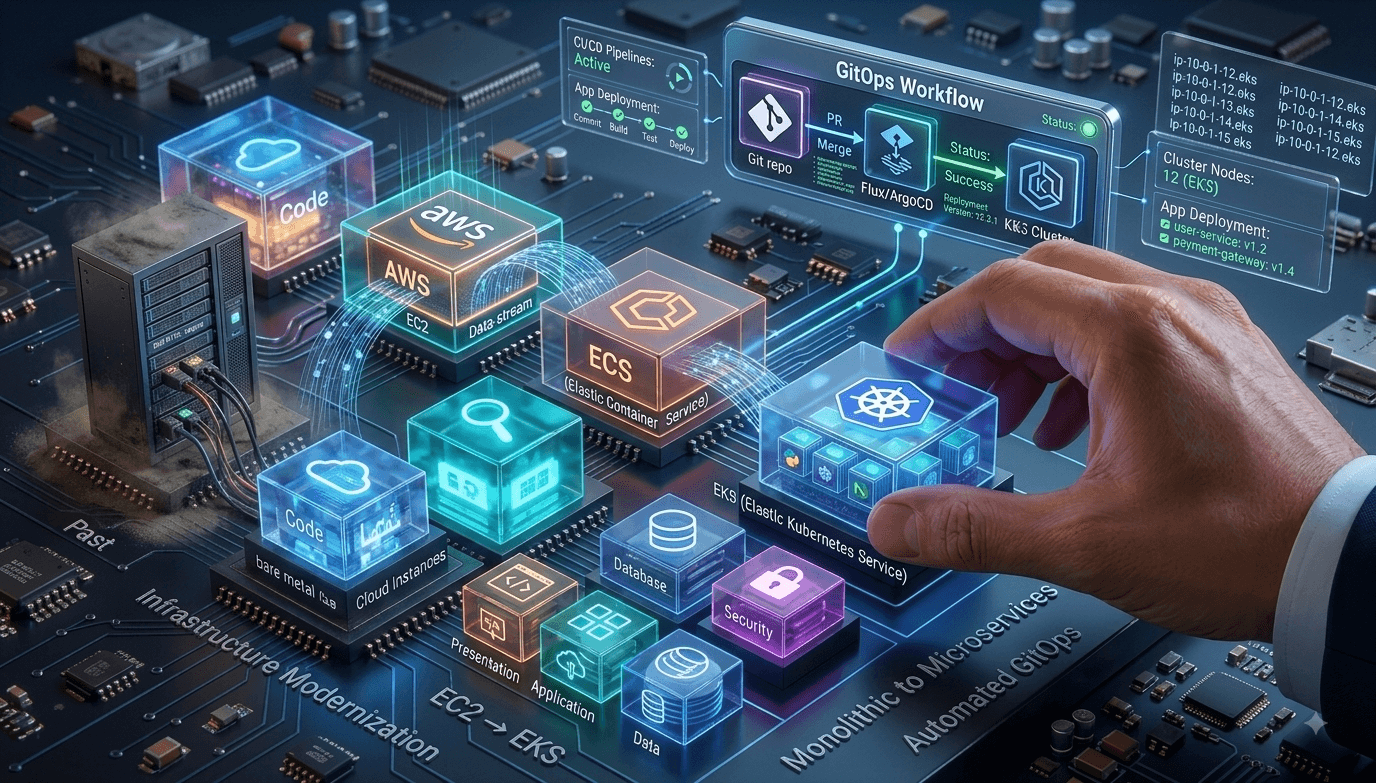
We move legacy VMware, EC2, and ECS workloads to Kubernetes-native platforms — with automated CI/CD, GitOps, and security built in at every step, not bolted on after.
Application Modernization
Modernization should do more than move workloads to new infrastructure. It should make your technology easier to operate, faster to change, and ready to scale with your business.
Our application modernization services help organizations transform legacy environments into secure, scalable cloud-native platforms while minimizing disruption to critical operations.
The modernization path
Where you start
Refactor in place
CI/CD + GitOps
Where you land
Platform capabilities
Reduce operational complexity by replacing fragmented infrastructure and manual processes with standardized cloud-native platforms.
Modernize legacy workloads through containerization, refactoring, and Kubernetes adoption without unnecessary disruption — this is legacy application modernization done in stages, not a forced rewrite.
Accelerate software delivery with automated CI/CD, GitOps, and repeatable deployment workflows.
Build for scale with cloud native transformation architectures designed to support growing applications, teams, and workloads.
Standardize Kubernetes operations across environments for greater consistency, reliability, and control.
Automate application delivery from code commit through production deployment.
Improve visibility and resilience with integrated monitoring, observability, security, and operational management.
From legacy application modernization to Kubernetes modernization service work, we help organizations move toward a cloud-native operating model built for long-term performance and growth.
Transform legacy infrastructure and applications into scalable, automated, cloud-native platforms.
VMware modernization establishes the right path toward cloud-native infrastructure and Kubernetes.
Containerize suitable VM-based workloads and transition them via VMware to Kubernetes migration into Kubernetes-ready architectures.
EC2 to EKS migration moves workloads to Amazon EKS and modernizes application delivery around Kubernetes.
ECS to EKS migration transitions workloads to establish a standardized Kubernetes platform across your environment.
Monolithic to microservices migration breaks down monolithic applications into independently deployable, cloud-native services.
Application refactoring service and containerization services modernize legacy applications through targeted refactoring, without unnecessary rewrites.
Move from manual release processes to automated, repeatable software delivery. Our CI/CD automation services connect code, testing, security, and deployment into streamlined CI/CD pipeline services that help engineering teams release faster with greater control and fewer operational bottlenecks.
Git Push & Webhook Trigger
Parallel Container Builds
SAST & Vulnerability Gate
Canary / Blue-Green Rollout
Automated Health Checks
DevOps CI/CD implementation that builds end-to-end delivery pipelines automating the path from code commit to production — automated builds and testing, security and quality checks, automated deployments, environment promotion, release approvals, and rollback, all as one automated CI/CD pipeline AWS workflow.
Faster releases with less manual effort and lower deployment risk.
CI/CD for Kubernetes and EKS environments — build, test, security, image management, deployment, and environment promotion integrated into one consistent Kubernetes delivery workflow.
Consistent and repeatable application delivery across Kubernetes environments.
CI/CD pipeline optimization for existing pipelines — we assess your current delivery process and eliminate unnecessary manual steps, tooling gaps, and deployment bottlenecks.
Shorter release cycles, improved engineering productivity, and more reliable deployments.
Section 05 — Kubernetes Delivery
Bring consistency and control to Kubernetes application delivery with Helm & GitOps. We establish standardized deployment configurations and automated workflows that keep application environments aligned while reducing manual intervention and deployment risk.
How it stays in sync
Single source of truth
Desired state lives in Git — reviewed, versioned, and audited like code.
Continuous reconciliation
ArgoCD compares live cluster state against Git on an ongoing loop, not just at deploy time.
Self-healing by default
Drift is detected and corrected automatically — no manual kubectl apply, ever.
capabilities.yaml
● Synced# 01
kind: Helm Chart Development
spec.description
Helm chart development services create reusable, maintainable charts that standardize how applications are configured and deployed across Kubernetes environments.
status.outcome
Consistent deployments, easier application management, and reduced configuration overhead.
---
# 02
kind: GitOps Implementation
spec.description
GitOps implementation services manage application and infrastructure configuration through version control, automatically reconciled with your Kubernetes environments.
status.outcome
Greater deployment consistency, traceability, and operational control.
---
# 03
kind: ArgoCD Implementation
spec.description
ArgoCD implementation automates application delivery across Kubernetes and EKS environments — deployment workflows, environment sync, access controls, and release processes configured around your operations.
status.outcome
Faster, more predictable deployments with clear visibility into application state.
---
# 04
kind: Kubernetes GitOps Workflows
spec.description
Repeatable Kubernetes GitOps workflow design across development, staging, and production, giving engineering and operations teams a consistent way to manage releases.
status.outcome
Standardized releases, fewer configuration inconsistencies, and stronger control across environments.
Section 06 — Service Communication
As applications become more distributed, managing communication between hundreds of services can introduce complexity, reliability risks, and security challenges. Our service mesh implementation services provide the control layer needed to securely connect, manage, and observe microservices across Kubernetes environments.
What's actually running between your services
Encrypted by default
Every hop between sidecars uses mutual TLS — no service talks to another in plaintext.
No hardcoded IPs
Services resolve each other by name; the registry keeps pace as pods scale, move, and restart.
One policy, everywhere
Traffic rules, retries, and access controls are enforced consistently across the mesh, not per service.
Service mesh implementation to control service-to-service traffic, improve application resilience, and gain greater visibility into distributed workloads.
Istio implementation services deploy and configure traffic routing, service communication, security policies, and resilience across Kubernetes-based microservices.
Kubernetes service discovery establishes reliable communication patterns so applications can locate and reach the services they depend on — core to any microservices service discovery strategy.
Service mesh security strengthens communication between microservices with identity-based controls, secure service communication, and traffic policies.
Running Kubernetes at scale requires more than keeping clusters online. We provide Kubernetes management services that keep your platform secure, reliable, optimized, and ready to support business-critical applications.
cluster-topology
Kubernetes cluster management takes the operational complexity out of running Kubernetes — configuration, workloads, networking, scaling, upgrades, and day-to-day platform health, all managed.
→A stable and consistently managed Kubernetes platform without the operational burden on your internal teams.
EKS managed services and broader managed Kubernetes services cover cluster operations, workload management, performance, security, and infrastructure optimization for your Amazon EKS environment.
→A production-ready EKS platform that remains reliable, scalable, and optimized as your business grows.
Kubernetes support services keep production workloads running with proactive monitoring, troubleshooting, incident support, and continuous operational assistance.
→Faster issue resolution, reduced operational risk, and greater confidence in your Kubernetes environment.
Continuous improvement of Kubernetes performance, resource utilization, scalability, and security based on your workload requirements and business priorities.
→Better platform efficiency, predictable performance, and a Kubernetes environment built for long-term growth.
Section 09 — Platform Visibility
Know what is happening across your applications, Kubernetes clusters, and infrastructure before small issues become production incidents. Our EKS observability services bring together metrics, logs, traces, and operational signals to give engineering and leadership teams a clearer view of platform health and performance.
trace: checkout_flow — 120ms
5 spansSignals, not just symptoms
Metrics, logs, and traces are correlated together, not scattered across separate tools.
Root cause in minutes
Trace a slow checkout straight to the exact service and call that caused it.
Visibility into cost, not just uptime
Resource usage and spend are visible alongside performance, not tracked separately.
Kubernetes monitoring services covering cluster health, nodes, workloads, applications, and critical infrastructure signals across your EKS environment.
→Earlier detection of performance issues, failures, and abnormal workload behavior.
EKS logging and monitoring centralizes application and infrastructure logs, metrics, and operational data into one consistent view.
→Faster troubleshooting and better visibility into application and platform performance.
Distributed tracing Kubernetes traces requests across microservices to identify latency, bottlenecks, dependency failures, and performance issues.
→Faster root-cause analysis and improved application reliability.
Kubernetes observability tools connected to workload performance and resource consumption surface inefficiencies — this is EKS cost observability, not just uptime monitoring.
→Better platform performance, resource utilization, and cost control.
Measurable improvements from teams that trusted us with their most important infrastructure.
FinTech·Lending
40%
Cost cut
3×
Deploy speed
99.9%
Uptime
Modernised core lending infrastructure on AWS with an automated CI/CD platform, lowering infrastructure spend while releasing more often.
Automotive·Marketplace
99.9%
Available
5×
Scale ready
Built a resilient AWS platform designed for high traffic, multi-region continuity, and enterprise security compliance.
AI Platform·Enterprise
100%
Automated
MLOps
Enabled
Designed and deployed a complete MLOps foundation for dependable model serving, monitoring pipelines, and automated workflows.
Blockchain·NFT
3×
Productivity
Mins
Deploy time
Implemented a fully automated, EKS-driven DevOps platform to support a blockchain-based NFT tokenization platform.
Media·Streaming
200k+
Concurrent users
<10s
Latency
Optimized cloud infrastructure for real-time election updates, scaling to handle over 10 million requests with sub-10 second video latency.
Insurance·DevSecOps
93%
Faster Deploy
100%
Traceability
Full-Stack DevSecOps Transformation from Ground Zero, enabling cloud adoption for non-sensitive workloads and streamlining hybrid delivery.
Technology·Migration
40%
Savings
80%
Faster Deploy
Modernizing Legacy Infrastructure: Migrating from On-Prem VMware to Native AWS for Enhanced Scalability, Security & Cost Optimization.
FinTech·AI / LLM
5x
Inference Speed
50%
GPU Cost Drop
Scalable Multi-GPU On-Prem LLM Deployment using OpenShift, enabling secure, compliant, and cost-effective real-time AI inference.
Blockchain·Cloud / Azure
30%
Cost Reduction
3x
Transaction Load
Transformed cloud infrastructure with Azure Landing Zones, achieving unmatched scalability, security, and efficiency for DeFi platforms.
Trusted by forward-thinking teams



Everything you need to know about modernizing your applications with DevSecCops.ai — and if it's not here, our team is one message away.
Application modernization means transforming legacy applications, infrastructure, and delivery processes into scalable, secure, cloud-native platforms — through containerization, refactoring, microservices migration, Kubernetes adoption, CI/CD automation, and GitOps. We move through a staged path — Legacy → Containerized → Automated Delivery → Cloud-Native — so at every point you know exactly where your environment stands and what's next.
Rising infrastructure costs, slower release cycles, and growing difficulty securing or scaling your applications are usually the clearest signals. Rather than assuming modernization is the answer, we assess your actual workloads and dependencies first and tell you honestly whether it's worth doing — and if so, where to start.
It depends on the application — its architecture, business criticality, and technical debt all point to different answers. We work through a staged model: containerize in place, automate delivery, then orchestrate as a cloud-native platform — so each workload gets matched to its own strategy instead of one blanket approach applied to everything.
Yes — most of the work is targeted refactoring and containerization done in place, keeping the business logic that already works rather than rebuilding it. Where a full architectural shift genuinely pays off, we break monolithic applications into independently deployable microservices progressively, at a pace you set.
Yes, but not every VM is a good candidate — that's the first thing we determine, not assume. We assess your VMware environment workload by workload, containerize what's actually suitable, and leave the rest on a slower or different path rather than forcing a blanket migration that creates more risk than it removes.
Yes. The bigger question is usually less "can you" and more "will it disrupt what's already running" — and the answer is we design the EKS architecture and deployment automation around your existing traffic patterns first, then migrate in a sequence that avoids taking dependent services down together.
A standardized Kubernetes platform replaces fragmented, per-environment processes with one consistent way to deploy, scale, and manage containerized applications. We build this alongside automated CI/CD, GitOps, service mesh, and observability from day one — so what you get is a production-ready operating model, not infrastructure that merely happens to run containers.
Manual release processes are typically the biggest hidden bottleneck in modernization work. Our CI/CD pipelines connect commit, build, security scanning, deployment, and rollback into one automated flow — including canary and blue-green rollouts with health checks — so releases speed up without becoming riskier.
In practice, this is what prevents "someone changed something in prod and nobody knows what or why." Your desired application state lives in Git, versioned and reviewed like code, and ArgoCD continuously reconciles that state against your live cluster — catching and correcting drift automatically. The business result: deployments become predictable and auditable instead of a recurring source of firefighting.
We stage the work deliberately — assessment, dependency mapping, automated testing, then incremental rollout — instead of moving everything at once. Where it applies, canary and blue-green deployments with automated health checks mean a bad release gets caught and rolled back before your users ever notice it happened.
We don't hand off and disappear at go-live. Ongoing cluster management covers configuration, workload health, networking, scaling, and upgrades, paired with observability that correlates metrics, logs, and distributed traces — so a slow checkout flow, for example, traces straight to the exact service causing it, with cost visible right alongside performance.
This genuinely depends on how many workloads you're modernizing and which strategy applies to each one — there's no honest one-size-fits-all number we could give you here without seeing your environment. What we can promise is a straight answer, workload by workload, during a free assessment — no sales pressure, no obligation to move forward afterward.
Application refactoring service work changes how code is structured and packaged — via containerization services — without rewriting business logic from scratch, which is faster and lower-risk than a full rebuild.
Yes — our microservices migration services cover both directions: breaking down monoliths into microservices, and re-platforming existing microservices onto Kubernetes.
Talk to our modernization team about Application Modernization, VMware-to-Kubernetes, EC2 to EKS, ECS to EKS, Containerization, or Kubernetes. Get a clear modernization roadmap for your current environment, priorities, and migration risks before committing to a transformation — with no obligation.