Most engineering teams don't hit a scaling wall because their product is wrong — they hit it because the same five people are provisioning infrastructure, maintaining CI/CD pipelines, chasing cloud bills, and getting paged at 2 a.m., instead of building features. DevOps managed services exist to take that operational load off your team's plate without handing over control of your product. This guide covers what managed DevOps actually includes, how to tell if you need it, what a real engagement looks like, and how to choose a provider — so you can make the decision with evidence, not vendor pitches.
What Are DevOps Managed Services?
The term gets used loosely, so it's worth being precise about what DevOps managed services actually means — and what it doesn't — before deciding whether it's the right model for your team.
DevOps as a Managed Service: A Plain-Language Definition
A DevOps managed service is an ongoing arrangement where an external team operates and improves your cloud infrastructure, CI/CD pipelines, observability, security guardrails, and cloud costs — under agreed SLAs — while your engineers keep full ownership of application code and product direction. It's a continuous operating relationship, not a one-off project.
What Managed DevOps Does Not Mean
- It is not outsourcing your product engineering — your team still owns features, architecture decisions, and the roadmap.
- It is not a black box — a credible provider gives you visibility into infrastructure, pipelines, and incidents, not just a status email.
- It is not a replacement for an internal platform team if you already have one at scale — it's usually a complement, filling gaps or absorbing operational load.
- It is not just "on-call coverage" — reactive monitoring without automation and continuous improvement isn't managed DevOps, it's a help desk.
DevOps vs Managed Services vs DevOps Outsourcing
- DevOps (practice): the internal culture and toolchain of CI/CD, automation, and collaboration between dev and ops — something every team practices to some degree.
- Managed services (delivery model): a vendor operates a defined scope of infrastructure/tooling against SLAs, with your team retaining strategic control.
- DevOps outsourcing (different model entirely): handing over broader engineering decisions or staff-augmentation style delegation — closer to DevSecOps consulting engagements where scope includes advisory and build work, not just steady-state operations.
- In practice, most buyers actually want the middle option — managed operations with their team still owning product and architecture calls.
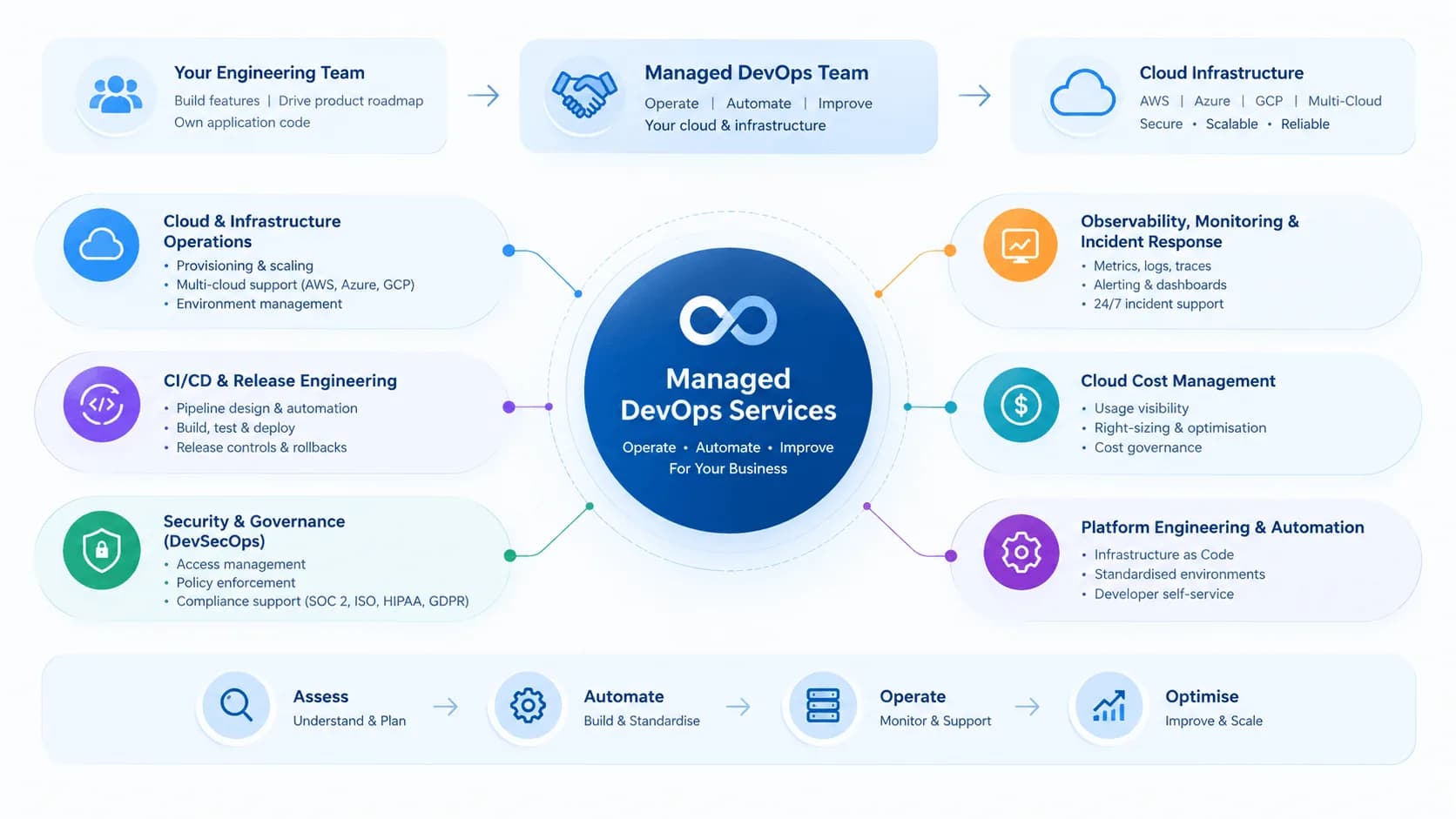
Six domains show up again and again across real engagements: cloud infrastructure, CI/CD, observability, security & governance, cloud cost management, and platform engineering — all operated as one connected system rather than six separate vendors.
Do You Need Managed DevOps Services? A Readiness Checklist
Managed DevOps isn't the right fit for every team at every stage. Use the signals below to pressure-test the decision before you talk to any vendor.
Signs You May Need a DevOps Managed Service Provider
- Deploys are infrequent or risky because nobody wants to be the one who breaks production on a Friday.
- Your most senior engineers spend more time on infrastructure firefighting than on product work.
- Cloud spend keeps climbing and nobody owns the answer to "why."
- There's no real on-call rotation, or the same two people absorb every incident.
- Compliance requirements (SOC 2, ISO 27001, HIPAA, GDPR) are arriving faster than your team can build controls for them.
- You're about to raise a round, enter an enterprise sales cycle, or scale headcount, and your infrastructure wasn't built for that scrutiny.
When You Probably Don't Need One
- You already have a dedicated platform/SRE team with clear ownership and healthy on-call load.
- Your infrastructure footprint is small and stable, with low deployment frequency and low business risk from downtime.
- You're pre-product-market-fit and still changing architecture weekly — a managed provider can't optimize a moving target yet.
- Budget realistically can't support a managed engagement — in that case, fix the highest-risk gap yourself first (usually backups, access control, or basic monitoring).
- If 3 or more of the "signs you may need one" apply, and none of the "probably don't need one" conditions block you — it's worth scoping a conversation.
- If you're unsure, a low-commitment first step is a short cloud and DevOps health assessment rather than a full managed engagement — it tells you where the actual gaps are before you commit to a scope.
What's Included in DevOps Infrastructure Management Services?
Scope varies by provider, but a credible DevOps managed service generally covers six domains. Here's what should realistically be inside each one.
1. Cloud & Infrastructure Operations
- Provisioning, scaling, and lifecycle management across cloud migration and steady-state managed cloud services.
- Infrastructure as code for every environment, so nothing is a hand-built snowflake — see our Terraform consulting services.
- Multi-cloud and hybrid support across AWS, Azure, and GCP, including environment parity between staging and production.
- Capacity planning and right-sizing tied to actual usage, not guesswork.
2. CI/CD & Release Engineering
- Pipeline design, build/test/deploy automation, and progressive delivery — see our CI/CD pipelines services.
- GitOps-based delivery so infrastructure and release state live in version control, not in someone's head — see GitOps consulting.
- Release controls: rollbacks, canary/blue-green strategies, and approval gates for high-risk changes.
- Reducing deployment lead time and change failure rate as tracked outcomes, not vanity metrics.
3. Observability, Monitoring & Incident Response
- Observability across metrics, logs, and traces — with monitoring, logging, and alerting unified into dashboards your team actually looks at.
- Alerting tuned to reduce noise, not just forward every warning to a Slack channel nobody reads.
- 24/7 incident response with defined severity levels and escalation paths — backed by high availability & backup and disaster recovery practices.
- Postmortems that produce fixes, not just a document nobody revisits.
4. Security & Governance (DevSecOps)
- Security & Governance (DevSecOps) brings access management, policy enforcement, and compliance into the same operating model as everything else.
- Access management, least-privilege IAM, and policy enforcement — see our zero trust architecture services.
- Compliance support mapped to real frameworks — SOC 2, ISO 27001, HIPAA, GDPR — through our compliance support.
- Secrets management, vulnerability scanning in the pipeline, and audit-ready logging.
- This is also where DevOps and security stop being separate conversations — see our full guide on choosing the right DevSecOps company.
5. Cloud Cost Management
- Usage visibility and tagging so spend is attributable to a team or feature, not a mystery line item — see our Cloud Cost Management services.
- Right-sizing, reserved capacity, and workload scheduling for cloud cost optimisation — including Karpenter-based cost optimization.
- Cost governance built into the pipeline, so a bad config can't silently 10x a bill before anyone notices.
6. Platform Engineering & Automation
- Platform Engineering & Automation turns one-off scripts into reusable paved roads for every team.
- Infrastructure as code and reusable modules so new environments are provisioned the same way every time.
- Standardized, self-service environments that reduce the number of tickets your engineers have to file to get unblocked.
- Developer self-service through an internal platform, including automation of repetitive operational tasks and our platform engineering AI agent.
How Managed DevOps Changes Your Engineering Operating Model
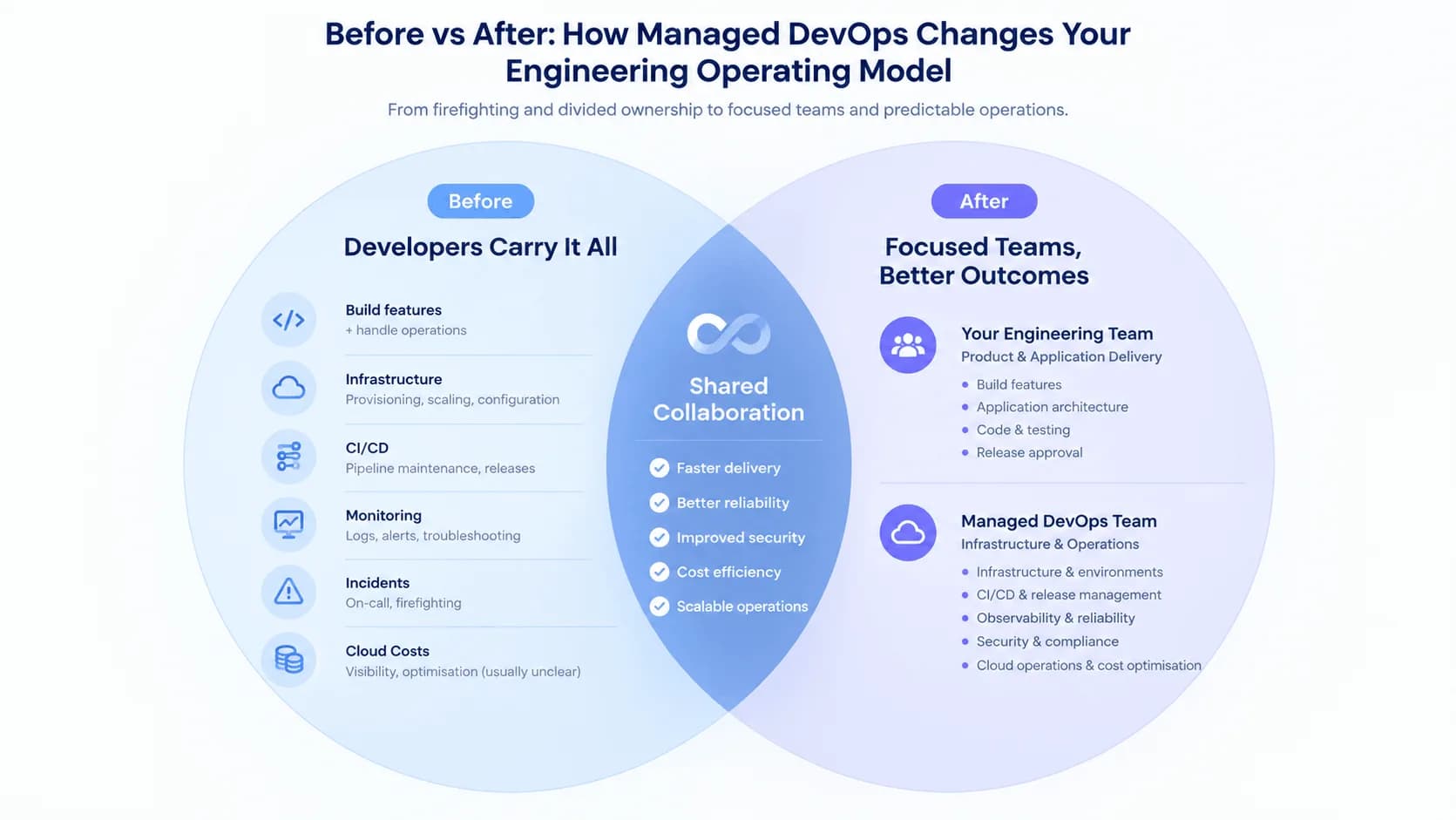
The clearest way to see the shift is to compare how responsibilities split before and after a managed DevOps engagement.
The table below breaks this down area by area — infrastructure, CI/CD, monitoring, incidents, and cloud costs — comparing how each is handled before and after a managed DevOps engagement.
| Area | Before: Developers Carry It All | With Managed DevOps |
|---|---|---|
| Infrastructure | Provisioned and scaled ad hoc by whoever has time | Standardized, automated, and owned by the managed team |
| CI/CD | Pipelines maintained reactively, often by one person | Actively maintained with release controls and rollbacks |
| Monitoring | Logs and alerts checked only after something breaks | Continuous observability with tuned, actionable alerts |
| Incidents | Whoever's online handles on-call and firefighting | Defined severity levels, escalation paths, 24/7 coverage |
| Cloud costs | Visibility is unclear; spend creeps upward unnoticed | Usage tracked, right-sized, and governed continuously |
Visually, the shift isn't about doing less — it's about splitting ownership so your engineering team focuses on product delivery while a managed team owns infrastructure, operations, security, and cost as a connected system.
Before: a payment API starts erroring intermittently at 11 p.m. The on-call engineer — who also owns three product features — gets paged, spends two hours finding the root cause in unstructured logs, and ships a manual fix without a postmortem. The same failure mode recurs six weeks later.With managed DevOps: the same error pattern triggers a tuned alert tied to a known runbook. The managed team resolves it within SLA, root-causes it with trace data, and ships an automated guardrail so the failure mode can't recur silently. Your engineer never gets paged.
Not sure where your biggest operational gaps actually are? A short readiness assessment answers that before you scope anything bigger.
Not sure where your biggest operational gaps are?
Get My DevOps Readiness AssessmentWho Owns What? A Responsibility Matrix
The most common reason managed DevOps engagements stall isn't technical — it's unclear ownership. A written responsibility matrix, agreed before the engagement starts, prevents that. The table below shows a typical split.
| Responsibility | Your Team | Managed DevOps Team |
|---|---|---|
| Application code & features | Owns | Not involved |
| Infrastructure provisioning | Requests / approves | Owns & automates |
| CI/CD pipeline operation | Reviews releases | Owns & maintains |
| Monitoring & alerting | Consumes dashboards | Owns & tunes |
| Incident response (infra) | Informed / escalation path | Owns first response |
| Security policy & compliance scope | Defines requirements | Implements & enforces |
| Cloud cost targets | Sets budget | Owns optimization |
| Architecture & product roadmap | Owns | Advises when asked |
How a Managed DevOps Engagement Works: From Assessment to Optimisation
A credible engagement follows a defined sequence rather than jumping straight to automation. Each phase has a distinct goal.
- Assess: audit current infrastructure, pipelines, security posture, and cost — establish the real baseline, not assumptions.
- Prioritise: rank gaps by business risk and effort, so the first six weeks fix what actually matters, not what's easiest.
- Stabilise: fix the highest-risk issues first — usually backups, access control, and alerting gaps — before anything else.
- Automate: replace manual, error-prone processes with infrastructure as code, CI/CD, and policy as code.
- Operate: run day-to-day operations against agreed SLAs, with on-call coverage and incident response in place.
- Optimise: continuously improve cost, performance, and reliability using the metrics gathered during Operate.
How to Measure the Success of Managed DevOps
If a provider can't point to metrics, you have no way to know whether the engagement is working. These are the ones worth tracking from day one.
- Deployment frequency — how often you ship to production without drama.
- Change failure rate — the percentage of deployments that cause an incident or require a rollback.
- Mean time to recovery (MTTR) — how fast an incident gets resolved once detected.
- Mean time to detect (MTTD) — how fast you notice something is wrong in the first place.
- Cloud cost per unit of usage — not just total spend, but spend relative to traffic or revenue.
- On-call burden — pages per week landing on your own engineers, trending down over time.
A Simple Framework: Baseline → Improvement → Target
- Month 0 (baseline): measure every metric above honestly, even if the numbers are embarrassing — this is the only way to prove improvement later.
- Month 3 (stabilisation): expect fewer repeat incidents and a documented runbook for the top failure modes, more than dramatic metric swings.
- Month 6–12 (optimisation): deployment frequency up, change failure rate down, MTTR materially shorter, and cloud cost trending flat or down relative to usage.
Managed DevOps vs In-House DevOps Team: Which Model Fits?
Managed services aren't a universal replacement for hiring — the right model depends on your stage, budget, and how specialized your infrastructure needs are. The Managed DevOps vs In-House DevOps Team decision often comes down to similar trade-offs as choosing between contract and full-time engineers.
- In-house team: makes sense once you have enough scale to keep 3+ specialized engineers (SRE, platform, security) fully utilized — expensive below that threshold, and slow to hire well.
- Fully managed: fastest path to mature operations without hiring risk — best when you don't yet need (or can't yet justify) a full internal platform function.
- Hybrid: a small internal team owns strategy and product-specific needs, while a managed provider runs steady-state operations — common for mid-stage companies scaling past their first platform hire.
How to Choose a DevOps Managed Service Provider
Most providers sound similar in a sales call unless you ask for a case study from a customer with a similar setup. Knowing how to choose a DevOps managed service provider before you start calls saves weeks of back-and-forth — these eight criteria are where the real differences show up.
- Multi-cloud depth: do they have real production experience across AWS, Azure, and GCP — or only one?
- Security-first delivery: is DevSecOps embedded in the pipeline, or bolted on as an afterthought?
- Transparent SLAs: are response times, escalation paths, and uptime commitments written down, not implied?
- Automation-first approach: do they reduce manual toil over time, or keep you dependent on their on-call forever?
- Cost accountability: can they show cost-optimization outcomes from past engagements, with real numbers?
- Communication model: do you get a named team and real visibility, or a ticket queue and a dashboard you never log into?
- Compliance experience: have they actually taken a client through SOC 2, ISO 27001, HIPAA, or GDPR audits — not just claim familiarity?
- Exit flexibility: can you take infrastructure as code and documentation with you if the engagement ends? If not, that's a lock-in risk.
Scoring providers against these eight criteria yourself? Talk to us and we'll walk you through the evaluation checklist.
Scoring providers (or your own team) against real controls? Our free DevOps Readiness Checklist covers 79 checks across 12 areas in about 10 minutes.
How Much Do DevOps Managed Services Cost?
Pricing varies widely because scope varies widely. Rather than quote a number that won't apply to your situation, here's what actually drives the price.
What Affects the Price
- Infrastructure footprint — number of environments, services, and cloud accounts under management.
- SLA tightness — 24/7 sub-15-minute response costs more than business-hours best-effort.
- Compliance scope — SOC 2 or HIPAA-aligned operations require more rigor (and more hours) than a startup with no formal compliance target.
- Current state of automation — a team starting from manual, undocumented infrastructure needs more stabilisation work upfront than one that's already using infrastructure as code.
Common Engagement Models
- Fixed monthly retainer: predictable cost for a defined scope — most common for steady-state operations.
- Tiered support plans: pricing scales with response-time SLA and infrastructure size.
- Project + retainer: an initial stabilisation/migration project, followed by ongoing managed operations once the environment is in a known-good state.
Security & Access Governance in Managed DevOps
Handing infrastructure operations to an external team raises a fair question: who can touch what, and how is that controlled? Good providers answer this before you have to ask.
What Good Looks Like
- Least-privilege access, scoped to exactly what's needed for the agreed task — not blanket admin credentials.
- Time-bound and auditable access, with every privileged action logged and reviewable by your team.
- Clear separation between the provider's identity and your production credentials — no shared static secrets.
- Compliance-aligned controls mapped to the framework you actually need (SOC 2, ISO 27001, HIPAA, GDPR).
- Pipeline security practices — scanning, secrets detection, and dependency checks — catch issues before they ever reach production.
How Managed Access Should Work
- Access is granted through your own IAM/SSO, not a side channel the provider controls independently.
- Changes to production go through the same CI/CD and approval gates your own engineers would use.
- You retain the ability to revoke access immediately, at any time, without depending on the provider's cooperation.
- This is the same zero-trust principle covered in our zero trust architecture services — applied specifically to third-party operational access.
Common Mistakes to Avoid When Adopting Managed DevOps
- Signing a contract before an assessment — you can't scope a fair SLA without knowing the actual state of your infrastructure.
- Treating it as "set and forget" — the engagement still needs an internal owner on your side who reviews metrics and holds the provider accountable.
- Granting blanket access instead of scoped, auditable permissions.
- Ignoring the exit plan — if your infrastructure as code and documentation aren't portable, you've built a dependency, not a partnership.
- Choosing on price alone — the cheapest provider is rarely the cheapest once a poorly-handled incident costs you a day of downtime.
DevOps Managed Services FAQs
Q01Q: Is managed DevOps the same as DevOps outsourcing?
A: No. Managed DevOps keeps your team owning product and architecture decisions while a provider operates infrastructure, pipelines, and operations under SLAs. DevOps outsourcing goes further, handing over broader engineering decisions — see our breakdown of DevOps outsourcing services for that distinction.
Q02Can managed DevOps work with my existing engineering team?
Yes — that's the model, not an exception to it. Your engineers keep ownership of application code and roadmap; the managed team operates infrastructure, CI/CD, and operations alongside them, with a written responsibility matrix so nobody's guessing who owns what.
Q03Who owns production infrastructure in a managed DevOps model?
Access is granted through your own IAM/SSO, changes go through the same approval gates your engineers would use, and you retain the ability to revoke access at any time — the provider operates it, but you own it.
Q04Can managed DevOps support AWS, Azure, GCP, or multi-cloud?
Yes, provided the vendor has real production experience across each — ask for examples, not just a logo on their website. Multi-cloud depth is one of the evaluation criteria worth checking before you sign.
Q05Is managed DevOps only for large companies?
No. Startups use it to get mature operations without hiring a full platform team early. Enterprises use it to fill specialized gaps (FinOps, SRE, security) or to run specific cloud environments without growing headcount for every niche skill.
Q06Q: What happens if we want to bring DevOps back in-house?
A: A credible engagement is built for exit, not lock-in — infrastructure as code, documentation, and access should all be portable. If you're weighing that transition, our comparison of contract vs. full-time DevOps engineers covers the staffing side of bringing it back in-house.
Q07Does managed DevOps include 24/7 support?
It should for anything customer-facing — but confirm the actual SLA. "24/7 coverage" can mean a 15-minute response or a next-business-day callback; get response times and escalation paths in writing before you sign.
Build a More Reliable DevOps Operating Model
The decision isn't really "managed DevOps or not" — it's whether your engineers should keep absorbing operational risk that a focused, accountable team could carry instead. Start with an honest assessment of where the gaps actually are, not where you assume they are. Run our free DevSecOps security checklist for a quick read on your current posture, or talk to our team directly about scoping a managed DevOps engagement.
Ready to see where your DevOps operating model actually stands?
Talk to a DevOps Expert