Devseccops

Author: Admin

  • Need a Contract DevOps Engineer Fast? Here’s How Teams Scale in Days

    Need a Contract DevOps Engineer Fast? Here’s How Teams Scale in Days

    In today’s fast-paced digital landscape, businesses face mounting pressure to deploy software faster, scale infrastructure efficiently, and maintain high reliability—all while controlling costs. When urgent needs arise, such as launching a new feature, migrating to the cloud, or handling sudden traffic spikes, many teams turn to a contract DevOps engineer to bridge the gap quickly.

    Hiring a contract DevOps engineer allows organizations to access specialized expertise on-demand without the long-term commitment of full-time hires. This approach has become a go-to strategy for startups, enterprises, and mid-sized companies alike, enabling them to scale in days rather than months.

    Why Hiring a Full-Time DevOps Engineer Takes Too Long

    The DevOps talent market remains highly competitive. DevOps engineers must master a broad skill set: CI/CD pipelines, containerization (Docker, Kubernetes), cloud platforms (AWS, Azure, GCP), infrastructure as code (Terraform, Ansible), monitoring tools, and more. Finding someone with the right combination of technical depth, problem-solving ability, and cultural fit often takes 3-6 months or longer.

    Challenges include:

    • High demand outpacing supply
    • Lengthy interview processes involving technical assessments and scenario-based problem-solving
    • Competition from big tech firms offering premium salaries and benefits

    In urgent scenarios—like a production outage, compliance deadline, or product launch—these delays can be costly. This is where a DevOps engineer contract shines: platforms and specialized providers can match vetted talent in as little as 48 hours to a few days.

    Benefits of Hiring a Contract DevOps Engineer

    Opting for a contract DevOps engineer offers clear advantages over traditional full-time hiring:

    • Speed and Flexibility — Bring in experts for specific projects or durations, scaling up or down as needs change. No lengthy onboarding or severance concerns.
    • Cost-Effectiveness — Pay only for the work required, often at higher hourly rates but without benefits, taxes, or overhead. This avoids the full salary burden during slow periods.
    • Specialized Expertise — Contractors frequently bring niche experience from multiple industries and projects, introducing best practices your team might lack.
    • Risk Reduction — Test capabilities on short-term engagements before considering longer commitments.

    Compared to full-time roles, contract positions provide autonomy and variety for engineers while giving companies immediate access to top talent without long-term lock-in.

    DevOps Managed Services: A Scalable Alternative

    For teams needing ongoing support rather than a one-off fix, DevOps managed services provide a hands-off way to maintain robust operations. These services involve partnering with a provider that handles your entire DevOps ecosystem—automation, monitoring, deployments, and optimization.

    Key advantages include:

    • Predictable monthly pricing
    • 24/7 support and proactive issue resolution
    • Built-in scalability for growing workloads
    • Access to a team of experts rather than a single individual

    DevOps managed services eliminate the need to build and maintain an in-house team, freeing internal resources for core business innovation.

    DevOps Outsourcing Services for Rapid Scaling

    When speed is critical, DevOps outsourcing services deliver entire teams or dedicated engineers quickly. Outsourcing partners maintain large pools of pre-vetted DevOps professionals, often certified in major cloud platforms and tools.

    Benefits of DevOps outsourcing services:

    • Rapid Onboarding — Start work in days with minimal ramp-up time.
    • Cost Optimization — Flexible models reduce expenses compared to in-house builds.
    • Enhanced Reliability — Outsourced teams implement automated testing, continuous monitoring, and best practices for fewer outages.
    • Knowledge Transfer — Gain long-term improvements as external experts share insights with your staff.

    Many companies combine a contract DevOps engineer for immediate needs with ongoing DevOps outsourcing services for sustained growth.

    Platforms and Strategies to Hire Fast

    To secure a contract DevOps engineer quickly:

    1. Specialized Freelance Marketplaces — Use platforms like Upwork, Toptal, or Braintrust for vetted talent. Post detailed requirements and receive proposals within hours.
    2. Tech-Focused Networks — Sites like Arc.dev or Turing match candidates in 72 hours for freelancers or 14 days for full-time equivalents.
    3. Recruitment Partners — Work with agencies specializing in DevOps for screened, ready-to-start contractors.
    4. Clear Job Scopes — Define requirements precisely (e.g., Kubernetes migration, CI/CD setup) to attract the right fits fast.
    5. Quick Validation — Use short technical discussions or trial tasks to confirm expertise.

    These methods cut hiring time dramatically, often delivering results in under a week.

    The Emerging Role of GenAI for DevOps

    As DevOps evolves, GenAI for DevOps is transforming workflows. Generative AI tools automate code generation for scripts and infrastructure as code, optimize CI/CD pipelines, suggest fixes for issues, and even create monitoring dashboards.

    GenAI for DevOps boosts efficiency by:

    • Reducing manual boilerplate work
    • Accelerating troubleshooting
    • Enhancing quality through automated testing suggestions
    • Shortening time-to-market

    Integrating GenAI allows teams to focus on strategic tasks while AI handles repetitive ones, making contract or outsourced engineers even more productive.

    Conclusion: Scale Smart with the Right Approach

    Scaling DevOps capabilities in days is achievable with the right strategy. A contract DevOps engineer provides immediate impact for urgent projects, while DevOps managed services and DevOps outsourcing services ensure long-term efficiency. For teams embracing security integration, DevSecOps companies lead the way in building secure, automated pipelines.

    Looking ahead, innovations like those from devseccops.ai offer AI-powered platforms that automate DevSecOps, MLOps, CI/CD, compliance, and observability empowering teams to build for scale securely and efficiently.

    Whether you’re facing a tight deadline or planning sustainable growth, exploring a DevOps engineer contract or managed outsourcing can transform your operations quickly and cost-effectively.

  • DevOps Outsourcing Services: The Smart Way to Scale DevOps Without Expanding Your Team

    DevOps Outsourcing Services: The Smart Way to Scale DevOps Without Expanding Your Team

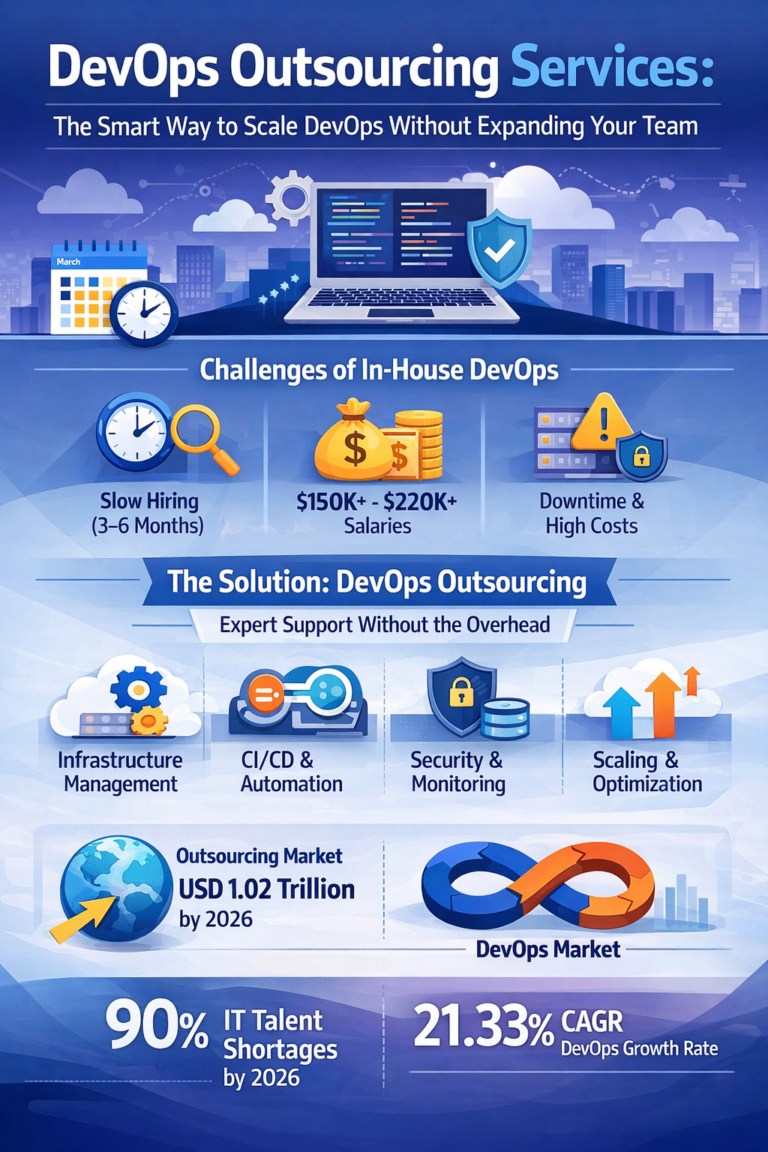
    In the competitive tech environment of March 2026, companies are racing to deliver high-quality software faster while managing rising cloud costs, security demands, and talent shortages. Traditional in-house DevOps teams come with heavy burdens: recruiting senior engineers can take 3–6 months, salaries often exceed $150,000–$220,000 loaded annually per person, and maintaining expertise in evolving tools like AI-driven automation, multi-cloud setups, and DevSecOps requires constant investment. The result? Bottlenecks in deployments, unexpected downtime, and budgets strained by overhead.

    DevOps Outsourcing Services provide a strategic escape route. By partnering with specialized providers, businesses offload infrastructure management, CI/CD pipelines, monitoring, scaling, security integration, and optimization to experts who operate at scale. This model delivers enterprise-level DevOps capabilities without recruiting, onboarding, or retaining a full team. The broader outsourcing services market is projected to reach around USD 1.02 trillion in 2026, growing at a 5.77% CAGR toward USD 1.35 trillion by 2031, while the DevOps market itself stands at approximately USD 19.57 billion in 2026 and is forecasted to hit USD 51.43 billion by 2031 at a 21.33% CAGR. DevOps-specific outsourcing thrives within this, fueled by persistent skills gaps (over 90% of organizations facing IT talent shortages by 2026) and the need for agile, cost-effective operations.

    The Growing Case for DevOps Outsourcing Services

    Why now? Several forces converge in 2026:

    • Talent Crunch: Finding qualified DevOps professionals remains challenging, with demand outpacing supply in cloud-native, Kubernetes, and AI Ops areas.
    • Cloud and AI Explosion: Workloads demand advanced automation, FinOps for cost control, and predictive monitoring—skills many internal teams lack.
    • Speed Imperative: Elite performers deploy multiple times daily with low failure rates; outsourcing accelerates this without internal friction.
    • Cost Pressures: Cloud spend continues rising, but outsourcing integrates FinOps to deliver 30–50% reductions through rightsizing, spot instances, and intelligent scaling.

    DevOps Outsourcing Services address these by providing dedicated, global teams with 24/7 coverage, pre-built frameworks, and outcome-focused SLAs.

    Key Advantages of DevOps Outsourcing Services

    • Substantial Cost Efficiency In-house DevOps for a small-to-medium team can cost $500,000–$1M+ yearly. Outsourcing often slashes this by 40–60% through predictable pricing (monthly retainers or usage-based), no benefits/taxes, and built-in economies of scale. Providers optimize cloud resources aggressively, turning potential waste into savings that frequently offset service fees.


    • Access to World-Class, Specialized Talent Providers maintain pools of certified experts in AWS, Azure, GCP, Kubernetes, Terraform, ArgoCD, Prometheus, and emerging AI tools. You gain immediate depth in niches like DevSecOps (shift-left security, automated compliance) or hybrid/multi-cloud orchestration—without years of internal upskilling.


    • Accelerated Velocity and Faster Time-to-Market Outsourced teams deploy battle-tested pipelines, IaC standards, GitOps workflows, and automated testing. Deployment frequency surges, lead times shrink dramatically (often from weeks to hours), and change failure rates drop. This enables quicker feature releases and competitive advantage.


    • Enhanced Reliability and Minimal Downtime Proactive 24/7 monitoring, self-healing automation, chaos engineering, and AI-driven anomaly detection achieve 99.99%+ uptime. MTTR falls to minutes, turning potential outages into seamless recoveries and boosting customer trust.


    • Built-in Security and Compliance Modern DevOps Outsourcing Services embed DevSecOps: vulnerability scanning, policy-as-code, and checks for SOC 2, GDPR, HIPAA integrated into pipelines. This reduces risks at velocity, critical in regulated industries.


    • Scalability and Agility Ramp up for launches, migrations, or seasonal peaks; scale down afterward—no headcount bloat or layoffs. Start with project-based outsourcing, evolve to full managed services as needs grow.

    Complementary Models for Maximum Flexibility

    DevOps Outsourcing Services integrate seamlessly with:

    • devops consulting services for strategy, audits, and roadmaps.


    • aws devops consulting services for deep AWS optimization (CodePipeline, EKS, Lambda).


    • kubernetes consulting services for advanced container orchestration and GitOps.


    • contract devops engineer or devops consulting freelancer for surge or niche support.

    This creates a tailored “DevOps-as-a-Service” ecosystem—full operations outsourced, with consulting for high-level guidance.

    Real-World Transformations

    A growing SaaS provider outsourced DevOps to handle Kubernetes migration and FinOps. Cloud costs dropped 45%, deployments increased 10x (from bi-weekly to multiple daily), and they avoided hiring 4–5 engineers—saving over $600,000 annually while focusing on product innovation.

    An enterprise in fintech used outsourcing for multi-cloud automation and DevSecOps. They achieved seamless scaling, proactive compliance, near-zero production failures, and faster regulatory approvals without team expansion.

    These stories highlight how DevOps Outsourcing Services turn operational challenges into strategic strengths.

    Choosing the Right DevOps Outsourcing Partner

    Prioritize providers with:

    • Proven SLAs (uptime, response times)


    • AI-enhanced automation and predictive insights


    • Strong compliance and security track record


    • Transparent pricing and success metrics


    • Experience across your cloud stack and industry

    The best partners act as extensions of your team, continuously optimizing and innovating.

    Conclusion: Embrace DevOps Outsourcing Services for Sustainable Growth

    In 2026, DevOps Outsourcing Services represent the intelligent path to elite DevOps performance—faster delivery, lower costs, higher reliability, and true focus on core business—without the overhead of team expansion. By combining devops consulting services, devops outsourcing services, aws devops consulting services, kubernetes consulting services, contract devops engineer, and devops consulting freelancer options, organizations scale efficiently and stay ahead.

    Ready to transform your DevOps without hiring headaches? Discover devseccops.ai their AI-powered platform offers comprehensive DevOps Outsourcing Services, managed operations, cloud optimization, DevSecOps, and expert talent access. With demonstrated results like significant cost reductions, accelerated releases, and proactive reliability, they handle the complexity so you can drive growth. Schedule a free consultation at devseccops.ai today and unlock scalable, high-velocity DevOps.

  • Hire a Contract DevOps Engineer:The Smart Way to Scale DevOps Without Full-Time Hiring

    Hire a Contract DevOps Engineer: The Smart Way to Scale DevOps Without Full-Time Hiring

    In the dynamic tech landscape of 2026, companies are under constant pressure to accelerate software delivery, optimize cloud infrastructure, and maintain high reliability—all while controlling costs. Building a full-time DevOps team is resource-intensive: the average DevOps engineer salary in the US hovers around $130,000–$150,000 annually (with total compensation often exceeding $150,000–$180,000 including benefits and bonuses), and senior roles can push well over $200,000. Recruitment, onboarding, training, and turnover add another 30–50% overhead, making a small in-house team easily cost $500,000–$1 million+ per year.

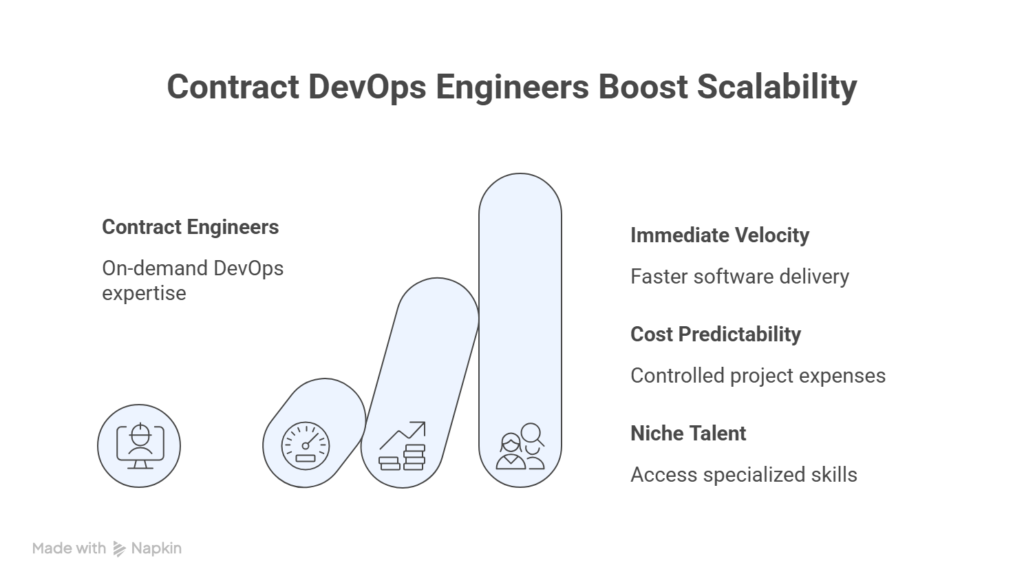
    Enter the contract DevOps engineer—a flexible, high-impact solution that lets businesses access top-tier expertise on-demand without long-term commitments. Hiring a contract DevOps engineer has become the go-to strategy for startups scaling rapidly, enterprises tackling migrations, and teams needing specialized skills for short- to medium-term projects. This approach delivers immediate velocity, cost predictability, and access to niche talent in a market where the global DevOps sector is valued at approximately USD 19.57 billion in 2026 and growing at a 21.33% CAGR toward USD 51.43 billion by 2031

    Why Choose a Contract DevOps Engineer Over Full-Time Hiring?

    The advantages are clear and quantifiable:

    • Speed to Impact Full-time hiring cycles average 3–6 months in competitive markets. A contract DevOps engineer can start within days or weeks via platforms, agencies, or networks. This rapid onboarding is crucial for time-sensitive initiatives like cloud migrations, Kubernetes implementations, or CI/CD overhauls.


    • Cost Efficiency Contract rates for a contract DevOps engineer typically range from $60–$140/hour depending on experience and location (mid-level around $70–$100/hour, seniors $100–$140+). For a 3–6 month engagement, total spend might be $50,000–$150,000—often 40–60% less than the fully loaded cost of a full-time hire for the same period. No benefits, payroll taxes, equipment, or severance risks. Many companies report 30–50% overall savings compared to permanent staff.


    • Access to Specialized Expertise Need deep Kubernetes orchestration, AWS multi-account strategies, Terraform mastery, or DevSecOps integration? A contract DevOps engineer often brings years of focused experience across industries. Full-time hires may require broad upskilling, while contractors deliver proven results immediately.


    • Scalability and Flexibility Scale up for launches or migrations, then scale down—no layoffs or idle capacity. This agility aligns perfectly with project-based work, seasonal demands, or testing new initiatives.


    • Reduced Risk If the fit isn’t perfect, the engagement ends cleanly. Contractors focus purely on deliverables, often with clear SLAs or milestones.

    When to Hire a Contract DevOps Engineer

    Common scenarios where a contract DevOps engineer shines:

    • Cloud Migrations or Modernizations — Moving to AWS, Azure, or GCP; adopting serverless or containerization.


    • CI/CD Pipeline Builds — Implementing automated testing, deployment, and rollback strategies.


    • Kubernetes Adoption — Setting up clusters, Helm charts, GitOps with ArgoCD/Flux.


    • Cost Optimization Projects — Applying FinOps to cut cloud bills by 30–50%.


    • DevSecOps Integration — Embedding security scans, compliance automation.


    • Temporary Gaps — Covering maternity leave, sabbaticals, or sudden departures.


    • Proof-of-Concept or Spike Work — Validating new tools or architectures quickly.

    For ongoing needs, many transition successful contractors to full-time or pair them with devops consulting services for long-term strategy.

    How to Hire a Contract DevOps Engineer Effectively

    1. Define Clear Scope and Outcomes Specify deliverables: e.g., “Automate EKS cluster provisioning with Terraform” or “Reduce deployment time from days to hours.”
    2. Choose the Right Sourcing Channel
      • Freelance platforms (Upwork, Toptal) for devops consulting freelancer talent.
      • Specialized agencies for vetted contract devops engineer professionals.
      • Networks like LinkedIn or DevOps communities.
    3. Vet Thoroughly Look for certifications (AWS Certified DevOps Engineer, CKAD/CKA), GitHub portfolios, and references. Conduct technical interviews focused on real-world problem-solving.
    4. Set Up Strong Collaboration Use tools like Slack, Jira, GitHub, and daily standups. Define success metrics and regular check-ins.
    5. Consider Hybrid Models Combine a contract devops engineer with devops outsourcing services for broader coverage or kubernetes consulting services for specialized depth.

    Integrating with Broader DevOps Strategies

    A contract DevOps engineer often works alongside:

    • devops consulting services for architecture roadmaps.
    • devops outsourcing services for managed operations.
    • aws devops consulting services for AWS-specific optimizations.
    • kubernetes consulting services for container expertise.

    This modular approach creates a flexible “DevOps-as-a-Service” ecosystem.

    Real-World Success Stories

    A SaaS startup hired a contract DevOps engineer for 4 months to build automated pipelines and migrate to Kubernetes. Deployment frequency rose from monthly to daily, cloud costs dropped 65%, and they avoided hiring two full-time roles—saving over $200,000 annually.

    An enterprise used a senior contract DevOps engineer for AWS optimization and DevSecOps setup. They achieved 99.99% uptime, automated compliance, and reduced incident response time dramatically—all without expanding permanent headcount.

    Potential Drawbacks and Mitigations

    Knowledge transfer can be limited—mitigate with documentation mandates and handover phases. Cultural fit varies—address with trial periods. For long-term needs, transition top performers to full-time.

    Conclusion: Scale Smart with a Contract DevOps Engineer

    Hiring a contract DevOps engineer offers unmatched flexibility, speed, and cost control in 2026’s competitive environment. Pair it with devops consulting services, devops outsourcing services, aws devops consulting services, kubernetes consulting services, or a devops consulting freelancer for comprehensive coverage without the full-time hiring burden.

    Businesses achieve faster scaling, lower costs, and elite DevOps performance by embracing this model. Ready to bring in expert help without the commitment? Explore devseccops.ai —their AI-powered platform connects you with vetted contract DevOps engineer talent, managed services, and DevSecOps expertise for seamless scaling. Visit devseccops.ai today for a free consultation and unlock high-velocity operations tailored to your needs.

  • DevOps Managed Services: How Companies Scale Faster Without Hiring Expensive DevOps Teams

    In the competitive digital economy of 2026, organizations face relentless pressure to deliver software faster, more securely, and at lower costs. Yet building an in-house DevOps team often feels like an insurmountable hurdle. Top DevOps engineers command median total compensation of $150,000–$165,000 annually in the United States alone, with senior roles at tech giants exceeding $200,000 when bonuses and equity are factored in. Add recruitment fees, ongoing training, benefits, and the reality of a global talent shortage, and the annual cost for even a small five-person team easily surpasses $1 million.

    This is where DevOps Managed Services emerge as a game-changing alternative. Instead of hiring full-time staff, companies partner with expert providers who handle infrastructure, automation, CI/CD pipelines, monitoring, security, and scaling — all on a flexible, pay-as-you-grow model. The result? Faster deployments, higher reliability, and dramatic cost savings without the overhead of an expensive internal team.

    The global DevOps market is exploding — projected to grow from approximately $14.95 billion in 2025 to $18.77 billion in 2026 at a CAGR of 25.6%, eventually reaching $47 billion by 2030. Organizations adopting DevOps practices report overwhelmingly positive outcomes, with 99% seeing measurable improvements and 61% noting enhanced deliverable quality. DevOps Managed Services sit at the heart of this transformation, allowing businesses of all sizes to leverage enterprise-grade expertise without the hiring headache.

    The Hidden Costs of Building an In-House DevOps Team

    Traditional DevOps hiring comes with multiple layers of expense. Beyond salaries, companies must invest in tools (Kubernetes clusters, AWS accounts, monitoring platforms), compliance certifications, and continuous upskilling. Talent attrition is another killer — the average DevOps professional stays just 1.8–2.5 years before moving on for higher pay.

    Many organizations also discover that even after hiring, their team spends 60–70% of time on maintenance rather than innovation. This creates bottlenecks: delayed feature releases, production outages, and mounting cloud bills. In contrast, DevOps Managed Services shift this burden entirely to specialists who operate at scale, using proven automation and AI-driven insights to deliver results far faster than a newly assembled internal team ever could.

    What Exactly Are DevOps Managed Services?

    DevOps Managed Services are comprehensive, outsourced solutions where a third-party provider takes end-to-end ownership of your DevOps lifecycle. This includes infrastructure as code (IaC), continuous integration and continuous delivery (CI/CD), container orchestration, monitoring, security (DevSecOps), and performance optimization — often delivered through a centralized AI-powered platform.

    Unlike one-off projects, true managed services operate 24/7 with SLAs guaranteeing 99.9% uptime. Providers monitor your systems proactively, auto-scale resources, optimize costs using FinOps principles, and ensure compliance with standards like SOC 2, ISO 27001, GDPR, and HIPAA. The beauty lies in flexibility: you pay only for what you use, scaling up during peak launches and down during quiet periods.

    Many providers bundle additional offerings:

    • devops consulting services for strategy and architecture reviews
    • devops outsourcing services for complete operational handover
    • aws devops consulting services tailored to Amazon Web Services environments
    • kubernetes consulting services for container orchestration expertise
    • Access to contract devops engineer resources on demand
    • Engagement with devops consulting freelancer specialists for niche projects

    This modular approach means you never overpay for unused capacity while always having world-class talent at your fingertips.

    How DevOps Managed Services Accelerate Scaling

    The core advantage of DevOps Managed Services is speed. Providers deploy pre-built, battle-tested pipelines that cut deployment times from weeks to hours. Automated IaC provisioning spins up environments in minutes rather than days. AI-driven observability detects issues before they impact users, while auto-scaling ensures applications handle sudden traffic spikes without manual intervention.

    Consider cloud cost management alone. Managed providers routinely deliver 40–60% reductions in cloud spend through rightsizing, spot instances, reserved capacity, and intelligent auto-scaling — savings that often exceed the entire service fee. One enterprise client reported 10X faster project delivery and a 50% reduction in execution time after adopting managed Kubernetes solutions, all without expanding their headcount.

    Security scales equally fast. Modern DevOps Managed Services embed “shift-left” security with automated vulnerability scanning, policy enforcement, and compliance checks directly in the CI/CD pipeline. This eliminates the traditional trade-off between speed and safety, delivering secure software at DevOps velocity.

    Integrating Specialized Expertise Without the Overhead

    Not every company needs the same depth of support. This is where the ecosystem of secondary services shines:

    devops consulting services provide expert audits and roadmaps, helping organizations identify bottlenecks and design future-proof architectures.

    devops outsourcing services take full operational responsibility, freeing internal teams to focus purely on product innovation.

    For AWS-centric businesses, aws devops consulting services deliver specialized expertise in services like CodePipeline, ECS, EKS, and Lambda — optimizing performance and cost specifically within the AWS ecosystem.

    Container-heavy organizations benefit enormously from kubernetes consulting services, which include cluster design, Helm chart management, GitOps implementation with ArgoCD, and multi-cluster federation for global scaling.

    When you need surgical support, engaging a contract devops engineer on a three- or six-month engagement delivers immediate impact without long-term commitment. Similarly, tapping a devops consulting freelancer allows access to niche specialists — perhaps an expert in Terraform or observability — at a fraction of full-time cost.

    Together, these options create a “DevOps-as-a-Service” menu that adapts perfectly to your growth stage and budget.

    Real-World Impact: Stories of Transformation

    A fintech startup struggling with manual deployments and ballooning AWS bills partnered with a DevOps Managed Services provider. Within 90 days, they achieved fully automated CI/CD pipelines, Kubernetes orchestration, and 55% cloud cost savings — all while their internal team of 12 developers focused exclusively on new features. Release frequency jumped from bi-weekly to multiple times daily.

    A healthcare provider facing strict compliance requirements used kubernetes consulting services and managed SRE to build a HIPAA-compliant platform. They avoided hiring three expensive specialists and instead gained 99.99% uptime with proactive incident management — all at predictable monthly cost.

    These examples are increasingly common. With 94% of businesses reporting that platform engineering (a cornerstone of managed services) helps them fully realize DevOps benefits, the evidence is clear: outsourcing operations accelerates scaling far more effectively than building internally.

    Addressing Common Objections

    Many leaders worry about losing control or data security. Reputable DevOps Managed Services providers counter this with transparent dashboards, role-based access, and shared responsibility models. You retain full visibility and decision-making power while experts handle the heavy lifting.

    Another concern is integration with existing tools. Leading platforms unify fragmented toolchains — GitHub, Jenkins, Terraform, Prometheus, ELK stack — into a single intelligent console, eliminating the “swivel-chair” problem that plagues many internal teams.

    Finally, the fear of vendor lock-in is addressed through multi-cloud architectures and open standards, ensuring portability across AWS, Azure, and GCP.

    Choosing the Right DevOps Managed Services Partner

    Look for providers who offer:

    • AI-powered automation and predictive analytics
    • Proven track record with measurable SLAs
    • Deep expertise across cloud platforms and Kubernetes
    • Transparent pricing with no hidden fees
    • Strong security and compliance credentials
    • Flexible engagement models (full managed, consulting, contract, or hybrid)

    The best partners don’t just maintain infrastructure — they act as strategic extensions of your team, continuously optimizing and innovating alongside you.

    Conclusion: Scale Smarter, Not Harder

    DevOps Managed Services represent the smartest path forward for companies that want enterprise-grade infrastructure and velocity without the massive expense and complexity of building expensive DevOps teams. By leveraging devops consulting services, devops outsourcing services, aws devops consulting services, kubernetes consulting services, contract devops engineer resources, and devops consulting freelancer expertise, organizations achieve faster scaling, lower costs, higher security, and true focus on core business innovation.

    The numbers speak for themselves: market growth, dramatic cost reductions, and near-universal positive outcomes prove that managed approaches outperform traditional hiring in 2026 and beyond.

    Ready to transform your operations and scale without the hiring headache? Explore how DevSecCops.ai can deliver exactly this through their AI-powered DevSecOps platform, Solution Accelerator, and end-to-end DevOps Managed Services. With proven results — including up to 70% cloud cost optimization, 50% faster execution, and 10X quicker delivery — their experts handle AWS, Kubernetes, CI/CD, security, and SRE so your team can build for scale. Book your free consultation today at devseccops.ai and start your journey toward frictionless, high-velocity DevOps. Your faster, more profitable future begins here.

  • Top DevSecOps Companies & How They Prevent 95% Cloud Threats

    1. Introduction: Why Cloud Threats Increased 400% in 2024–2026

    The numbers are no longer alarming — they are catastrophic. Cloud-based cyberattacks increased by 400% between 2024 and 2026, according to the CrowdStrike Global Threat Report. Every 39 seconds, a cloud environment is probed, exploited, or breached somewhere in the world. Ransomware groups have moved from targeting endpoints to targeting pipelines, storage buckets, and Kubernetes clusters directly.

    The root cause is not a lack of security tools. Enterprises today run an average of 76 security products simultaneously, per IBM Security. The real problem is fragmentation. Security teams operate in silos. Development teams ship code faster than security can review it. Cloud infrastructure scales faster than compliance can track it.

    This is precisely why top DevSecOps companies have become the most critical vendors in the enterprise technology stack. DevSecOps security automation closes the gap between speed and safety — embedding security directly into every stage of the software delivery pipeline. The organizations that have adopted this model are preventing up to 95% of cloud breaches before they happen. This blog breaks down who they are, what they do, and how you can apply the same principles to your own organization.


    2. What DevSecOps Really Means in 2026

    DevSecOps is not a product. It is not a team name. In 2026, it is an operating model — the practice of integrating security controls, compliance checks, and threat detection into every phase of software development, from the first line of code to production runtime.

    In practical terms, this means CI/CD security scanning runs on every commit. Cloud vulnerability monitoring never sleeps. Infrastructure-as-Code (IaC) is reviewed for misconfigurations before it is deployed. Runtime workload protection watches for anomalous behavior in live containers and serverless functions. And AI security platforms correlate signals across all of these layers to surface real threats, not noise.

    The companies that have mastered this model share three characteristics: they treat security as code, they automate policy enforcement at scale, and they use AI to predict vulnerabilities rather than simply react to them.


    3. Ranking Criteria: What Makes a DevSecOps Company World-Class?

    Before listing the top DevSecOps companies, it is important to define what “world-class” actually means in this space. The criteria used here reflect what enterprise security leaders evaluate in practice.

    Depth of automation is the first criterion — does the platform automate threat detection, remediation, and compliance reporting, or does it still rely heavily on manual workflows? Second is AI maturity — are the AI models trained on real-world threat data and capable of detecting novel attack patterns, not just known signatures? Third is pipeline integration — how seamlessly does the platform embed into existing CI/CD toolchains without slowing development velocity? Fourth is compliance coverage — does the platform support SOC 2, ISO 27001, HIPAA, PCI-DSS, FedRAMP, and GDPR out of the box? And fifth is proven enterprise outcomes — real customer case studies with measurable threat reduction metrics.


    4. Top DevSecOps Companies in 2026

    Palo Alto Networks (Prisma Cloud) remains the market leader in cloud security posture management. Prisma Cloud provides full-stack protection across code, infrastructure, and runtime, with native support for AWS, Azure, and GCP. Its AI-powered CSPM engine identifies cloud misconfigurations in real time and auto-remediates low-risk issues without human intervention.

    Wiz has risen rapidly to become the preferred cloud vulnerability monitoring platform for Fortune 500 companies. Its agentless architecture scans the entire cloud environment in minutes and produces a risk graph that correlates vulnerabilities, identities, and network exposure into a single attack path view. Wiz customers report a 70% reduction in critical cloud risk within 90 days of deployment.

    Snyk dominates developer-first security. It integrates directly into IDEs, Git repositories, and CI/CD pipelines to catch vulnerabilities in open-source dependencies, container images, and IaC templates before they reach production. Snyk’s database covers over 1.2 million known vulnerabilities and is updated continuously.

    CrowdStrike (Falcon Cloud Security) brings endpoint detection intelligence to cloud workload protection. Its runtime workload protection capabilities monitor container behavior in real time, detecting lateral movement, privilege escalation, and cryptomining activity at the kernel level — threats that traditional cloud security tools miss entirely.

    Checkmarx is the enterprise standard for CI/CD security scanning. Its SAST, DAST, SCA, and API security modules scan code across the entire SDLC and integrate with over 300 developer tools. Checkmarx One, its unified platform, reduces vulnerability remediation time by 40% through AI-driven prioritization.

    Aqua Security specializes in cloud-native application protection. Its platform secures containers, Kubernetes clusters, serverless functions, and virtual machines across hybrid and multi-cloud environments. Aqua’s supply chain security module is particularly strong, providing end-to-end integrity verification from source code to running workload.

    Lacework uses AI-driven anomaly detection to identify threats in cloud environments that rule-based systems cannot catch. Its Polygraph behavioral analysis engine builds a baseline of normal activity for every account, user, and workload — then flags deviations that indicate compromise. Lacework customers detect threats 80% faster than industry average.

    Orca Security provides agentless cloud vulnerability monitoring with a depth that agent-based tools rarely achieve. Its Side-Scanning technology reads cloud workload data directly from the cloud provider’s API, giving complete visibility into vulnerabilities, malware, misconfigurations, and sensitive data exposure without impacting production performance.

    Veracode is the leader in AI-driven penetration testing and application security testing at scale. Its cloud-based platform analyzes billions of lines of code annually and uses machine learning to identify the vulnerabilities most likely to be exploited — enabling security teams to prioritize remediation where it matters most.

    HashiCorp (Sentinel) rounds out the list with policy-as-code enforcement for infrastructure. Sentinel integrates with Terraform to enforce cloud misconfiguration protection before infrastructure is provisioned, stopping security debt before it enters the environment.


    5. How These Companies Prevent 95% of Cloud Breaches

    The 95% figure is not marketing language. It reflects what is achievable when multiple DevSecOps security automation layers work together. Here is how the top companies accomplish it.

    AI automation is the foundation. Platforms like Lacework and Wiz use machine learning to detect threats that would take human analysts days to identify — and they do it continuously, at cloud speed. The moment a misconfigured S3 bucket becomes public, or a container starts making unusual outbound connections, the system flags it and triggers a response.

    Policy enforcement eliminates entire categories of risk. Cloud misconfiguration protection through tools like Prisma Cloud and Sentinel ensures that insecure infrastructure never gets deployed in the first place. According to Gartner, 99% of cloud security failures through 2027 will be the customer’s fault — and the vast majority trace back to misconfiguration. Preventing misconfiguration at the IaC stage removes the single largest source of cloud breaches.

    CI/CD security scanning catches vulnerabilities when they are cheapest to fix. Snyk and Checkmarx data consistently show that a vulnerability fixed at the development stage costs 100 times less to remediate than one found in production. Scanning every pull request, every dependency update, and every container build creates a security gate that dramatically shrinks the attack surface.

    Runtime workload protection provides the final layer. Even with strong pre-deployment controls, zero-day vulnerabilities and supply chain attacks can still reach production. CrowdStrike and Aqua Security monitor live workloads for behavioral indicators of compromise and can isolate affected containers within seconds of detection.

    Cloud security posture management maintains the baseline. CSPM tools continuously audit cloud configurations against compliance frameworks and best practices — ensuring that drift, human error, and shadow IT do not silently erode the security posture over time.


    6. How Enterprises Can Choose the Right DevSecOps Partner

    Choosing among DevSecOps consulting services and platforms requires a structured evaluation. Start by identifying your most critical risk surface — is it your code, your cloud infrastructure, your containers, or your third-party dependencies? The answer determines which platform category to prioritize.

    Next, evaluate integration depth. The best DevSecOps platform in the world delivers zero value if it creates friction for your development teams. Require proof-of-concept integrations with your actual CI/CD toolchain before committing. Validate that security findings surface in the tools developers already use — Jira, Slack, GitHub — not just in a separate security dashboard that gets ignored.

    Compliance coverage matters enormously for regulated industries. Confirm that the platform produces audit-ready reports for the specific frameworks you are accountable to. And always ask for references from companies of similar size, stack, and regulatory environment.


    7. Cost, Compliance, and Risk Reduction Benefits

    The ROI case for DevSecOps security automation is well established. IBM’s Cost of a Data Breach Report 2024 found that organizations with mature DevSecOps practices save an average of $1.68 million per breach compared to those without. The cost of a DevSecOps platform — typically $50,000 to $500,000 annually depending on scale — is a fraction of a single avoided breach.

    Compliance automation alone justifies significant investment. Manual compliance audits for SOC 2 or ISO 27001 consume hundreds of engineering hours annually. Platforms with continuous compliance monitoring reduce that burden by over 70%, freeing security and engineering talent for higher-value work.

    Risk reduction is the ultimate metric. Enterprises that implement full-stack DevSecOps automation — covering code, infrastructure, runtime, and compliance — consistently report breach rates 80 to 95% lower than industry averages. That is not a marginal improvement. It is a structural transformation in security posture.


    8. Future: Autonomous Security Pipelines

    The next evolution in DevSecOps is already taking shape: fully autonomous security pipelines that detect, analyze, and remediate threats without human intervention. By 2028, Gartner forecasts that 40% of large enterprises will rely on AI security platforms capable of autonomously patching vulnerabilities, rotating compromised credentials, and isolating breached workloads — all in real time.

    AI-driven penetration testing will become continuous rather than periodic. Instead of annual red team exercises, enterprises will run AI agents that probe their own environments around the clock, identifying exploitable paths before adversaries do. Runtime workload protection will evolve from detection to prediction — flagging attack precursors before exploitation occurs.

    Cloud security posture management will expand to cover the full software supply chain, including third-party APIs, open-source libraries, and AI model dependencies. The boundary of what DevSecOps must protect is widening rapidly, and the platforms that adapt earliest will define the next decade of enterprise security.


    9. Conclusion & Call to Action

    The top DevSecOps companies in 2026 share a common approach: they automate everything that can be automated, enforce policy before problems occur, and use AI to operate at a speed and scale no human team can match. The result is a 95% reduction in successful cloud breaches — not through any single tool, but through layered, integrated, AI-driven security across the entire software delivery lifecycle.

    For enterprises ready to implement this model without stitching together a dozen point solutions, DevSecCops.ai is the answer. Built specifically for enterprise-scale DevSecOps, DevSecCops.ai delivers AI-driven security automation, continuous compliance monitoring, CI/CD security scanning, and cloud vulnerability monitoring in a single unified platform. It integrates with your existing toolchain in days, not months, and is designed to meet the compliance requirements of regulated industries from day one.

    If your organization is serious about preventing cloud threats before they become breaches, there is no better starting point.

    Visit DevSecCops.ai to request your enterprise security assessment and see exactly where your pipeline is exposed — and how to fix it.
  • Enterprise Guide: Choosing the Right AI Tools for Your DevOps Pipeline

    Enterprise Guide: Choosing the Right AI Tools for Your DevOps Pipeline

    1. Introduction: Why AI Is Becoming Mandatory in Enterprise DevOps

    Enterprise software delivery has changed dramatically. According to Gartner, by 2026 more than 80% of enterprises will have integrated AI-driven automation into their software delivery pipelines — up from less than 20% in 2022. The pressure is real: faster release cycles, growing security threats, and complex cloud-native infrastructures have made traditional DevOps practices insufficient.

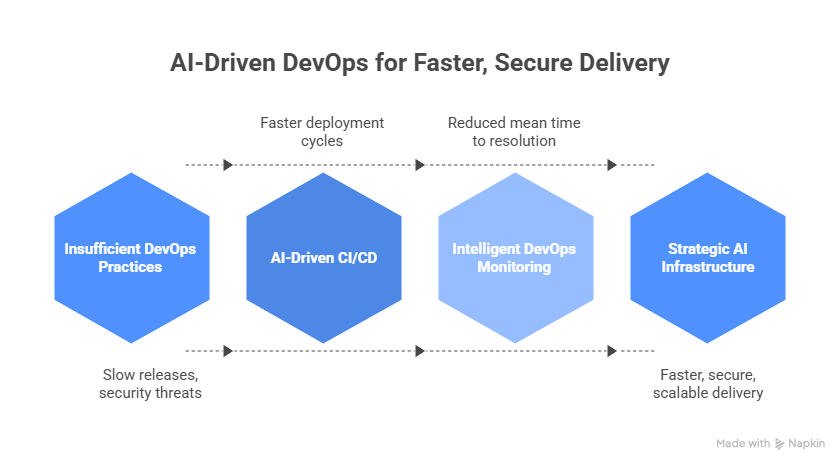
    AI tools for DevOps pipeline management are no longer optional add-ons. They are strategic infrastructure. Teams using AI-driven CI/CD and intelligent DevOps monitoring report up to 45% faster deployment cycles and a 60% reduction in mean time to resolution (MTTR), per the 2025 DORA State of DevOps Report.

    This guide is designed for engineering leaders, platform architects, and DevSecOps teams evaluating enterprise DevOps automation platforms. You will learn what to look for, what to avoid, and how to make AI adoption practical and scalable.

    2. Core Problems in Traditional DevOps Teams

    Before evaluating AI solutions, it helps to name the exact pain points that are slowing enterprises down today.

    Manual bottlenecks in CI/CD pipelines. Even with Jenkins or GitLab CI, most teams still rely on human judgment for release approvals, environment provisioning, and incident triage — all of which create delays and inconsistency.

    Alert fatigue and monitoring noise. Operations teams running large microservices architectures receive thousands of alerts daily. Without AI-based filtering and correlation, signal gets lost in noise.

    Reactive security posture. Traditional DevOps teams detect vulnerabilities after deployment. Shifting security left requires automation that most legacy toolchains do not support natively.

    Slow incident response. Without predictive DevOps analytics, root cause analysis is manual, time-consuming, and often based on guesswork rather than data.

    Lack of unified observability. Disparate tools for logging, tracing, and metrics create visibility gaps. Cloud-native DevOps tools need to integrate these into a single pane of glass.

    3. What Makes an AI Tool Enterprise-Ready? (Checklist)

    Not every AI DevOps platform is built for enterprise scale. Before purchasing or piloting any solution, validate it against this checklist:

    Seamless integration with existing CI/CD tools (Jenkins, GitHub Actions, GitLab, Azure DevOps). Role-based access control (RBAC) and audit logging for compliance. Support for on-premise, hybrid cloud, and multi-cloud deployments. SOC 2 Type II, ISO 27001, or FedRAMP certification for secure AI DevOps tools. Explainable AI outputs — decisions must be auditable, not black-box. Real-time and historical analytics dashboards for predictive DevOps analytics. API-first architecture enabling custom integrations and extensibility. SLA-backed uptime guarantees (99.9%+) and enterprise-grade support. Vendor lock-in avoidance — open standards and portable configurations. Proven ROI benchmarks — the vendor should provide customer case studies.

    4. Top Categories of AI DevOps Tools

    Enterprise DevOps AI platforms typically address five key functional areas. Understanding each category will help you assemble the right stack — or choose a platform that covers multiple layers.

    4.1 Intelligent DevOps Monitoring

    AI-driven monitoring tools go beyond threshold alerts. They use anomaly detection, time-series analysis, and machine learning to distinguish genuine incidents from noise. Platforms like Dynatrace Davis AI and New Relic AI correlate events across distributed systems and surface probable root causes in seconds, not hours. Enterprises using intelligent monitoring report a 40% reduction in false-positive alerts, according to Forrester Research.

    4.2 AI-Driven CI/CD

    AI in release management transforms static pipelines into adaptive systems. Tools such as Harness AI and LinearB analyze historical build data to predict test failures, prioritize flaky tests, and recommend optimal deployment windows. The result: fewer rollbacks, faster delivery, and data-backed release confidence. Teams using AI-driven CI/CD cut failed deployments by up to 35%, per the 2025 GitLab DevSecOps Survey.

    4.3 DevOps Security Automation

    DevOps security automation — often called DevSecOps — embeds security testing directly into the pipeline. Automated code quality scanning tools like Snyk, Checkmarx, and SonarQube with AI plugins detect vulnerabilities at the code, dependency, and container image level before they reach production. These tools reduce the cost of fixing a security flaw by up to 85% when caught at the development stage versus post-deployment, per IBM Security Cost of a Data Breach Report 2024.

    4.4 AI-Powered Observability

    Observability platforms combine metrics, logs, and traces into a unified context. AI layers on top of that context to surface insights humans would miss. Cloud-native DevOps tools like Honeycomb and Elastic Observability use predictive analytics to identify degradation trends before they become outages — a capability that traditional monitoring tools simply cannot replicate.

    4.5 AI-Augmented Testing

    AI testing tools like Testim, Mabl, and Applitools use visual AI and self-healing test automation to reduce test maintenance overhead — a significant cost for enterprise QA teams. These platforms also generate test cases from user behavior data, improving coverage without proportional manual effort.

    5. How to Integrate AI Tools Into Existing Pipelines

    Integration is where many enterprise AI initiatives stall. The key is a phased adoption model that minimizes disruption while delivering measurable value quickly.

    Phase 1 — Audit and Baseline (Weeks 1–4). Map your current pipeline stages. Identify manual handoffs, recurring failure points, and monitoring gaps. Establish baseline KPIs: deployment frequency, lead time, MTTR, and change failure rate.

    Phase 2 — Pilot on Non-Critical Workloads (Weeks 5–10). Deploy your chosen AI DevOps platform on a low-risk service or team. Focus on monitoring and observability first — these yield fast, visible ROI with minimal pipeline disruption.

    Phase 3 — Expand to CI/CD (Weeks 11–20). Integrate AI-driven CI/CD capabilities. Enable automated test prioritization, deployment risk scoring, and rollback recommendations. Validate against your Phase 1 baseline.

    Phase 4 — Embed Security Automation (Weeks 21–30). Add DevOps security automation across all active pipelines. Define security gates that auto-pass clean builds and flag vulnerabilities for human review rather than blocking all deployments.

    Phase 5 — Operationalize and Optimize (Ongoing). Build internal runbooks around AI recommendations. Train teams to trust — and verify — AI-generated insights. Continuously tune models using your organization’s own incident history.

    6. Cost, Scalability & Security Considerations

    Enterprise AI DevOps platforms vary widely in pricing model, scalability architecture, and security posture. Here is what to evaluate before signing a contract.

    Cost: Most enterprise DevOps AI platforms price on a per-seat, per-pipeline, or consumption-based model. Consumption-based pricing can scale unpredictably in large organizations. Negotiate a cap or commit pricing if you anticipate high usage volume. Always calculate the total cost of ownership (TCO) including integration engineering time, training, and ongoing tuning — not just the subscription fee.

    Scalability: Validate that the platform has been tested at your anticipated scale. Request case studies from companies with similar pipeline complexity and deployment frequency. Enterprise DevOps automation platforms should support horizontal scaling, multi-region deployment, and handle concurrent pipeline execution without degradation.

    Security: Secure AI DevOps tools must meet your data residency requirements. If your organization operates in regulated industries — finance, healthcare, government — verify that the vendor offers dedicated tenancy, data encryption at rest and in transit, and compliance with GDPR, HIPAA, or FedRAMP as applicable. Always review the vendor’s shared responsibility model.

    7. Mistakes Enterprises Make When Choosing AI DevOps Tools

    Even experienced engineering organizations make avoidable mistakes during AI DevOps tool selection. These are the most common — and most costly.

    Choosing breadth over fit. Platforms that promise to do everything often do nothing exceptionally well. Choose tools that solve your top two or three pain points deeply rather than covering all categories superficially.

    Ignoring change management. AI tool adoption fails when engineers feel replaced rather than augmented. Invest in training, create feedback loops, and communicate clearly that AI assists human judgment — it does not replace it.

    Skipping proof-of-concept (PoC) validation. Vendor demos are optimized for success. Always run a time-boxed PoC on real workloads with real constraints before committing.

    Underestimating integration complexity. AI DevOps platforms that do not have native connectors for your existing toolchain will require significant custom engineering. Budget for integration time explicitly.

    Treating AI as a set-and-forget solution. AI models drift as codebases and infrastructure evolve. Plan for quarterly model reviews and retraining to maintain accuracy and relevance.

    8. The Future of AI in DevOps (2026–2030)

    The next four years will bring a fundamental shift in how AI operates within DevOps — moving from assistive to autonomous, and from reactive to predictive.

    Autonomous pipelines will emerge as the dominant model by 2028. Gartner predicts that by 2028, agentic AI will autonomously handle over 30% of software release decisions without human intervention in early-adopter enterprises. These systems will self-heal failing builds, reroute deployments around failing infrastructure, and auto-remediate security vulnerabilities with verified patches.

    Predictive DevOps analytics will move from anomaly detection to full incident prevention. Models trained on years of pipeline telemetry will predict failures days in advance, giving platform teams time to act proactively. This shift will reduce unplanned downtime costs which IDC estimates at $400,000 per hour for large enterprises  dramatically.

    AI in release management will evolve to include business context awareness. Future systems will factor in customer impact, revenue risk, and compliance exposure when scoring deployment readiness not just technical metrics. Security will become fully embedded, with AI performing real-time threat modeling as code is written, rather than scanning finished artifacts.

    Finally, the convergence of DevOps, security, and compliance into unified AI-driven platforms — what is increasingly called DevSecOps automation — will make fragmented point solutions obsolete for enterprises operating at scale.

    9. Conclusion

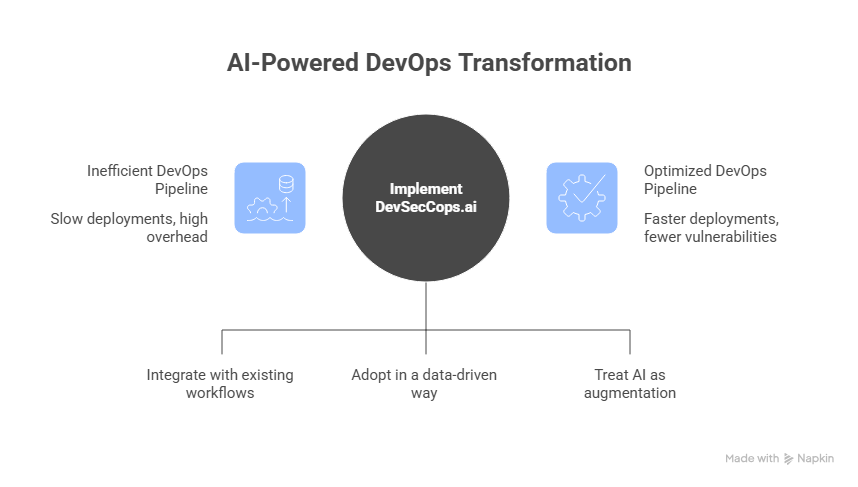
    Choosing the right AI tools for your DevOps pipeline is one of the highest-leverage decisions an enterprise engineering organization can make in 2026. The difference between teams that get it right and those that struggle comes down to three factors: selecting tools that integrate deeply with existing workflows, adopting in a phased and data-driven way, and treating AI as an augmentation layer rather than a replacement for engineering judgment.

    The categories that deliver the fastest and most measurable ROI — intelligent DevOps monitoring, AI-driven CI/CD, and DevOps security automation — should anchor your evaluation process. Everything else should complement those foundations.

    If you are ready to move from evaluation to execution, DevSecCops.ai is the platform built for exactly this challenge. As a purpose-built AI-driven DevSecOps automation platform for enterprises, DevSecCops.ai unifies monitoring, security, and release intelligence into a single, enterprise-grade platform. It integrates natively with your existing toolchain, meets the compliance standards your regulated industry demands, and delivers measurable outcomes faster deployments, fewer vulnerabilities, and lower operational overhead from day one.

    Schedule a personalized enterprise demo at DevSecCops.ai and see how AI-driven DevSecOps can transform your pipeline in 90 days or less.

  • How to Choose the Best DevSecOps Service Provider for Your Enterprise

    How to Choose the Best DevSecOps Service Provider for Your Enterprise

    Security has become the backbone of digital transformation in 2026. With cloud-native technologies, AI-driven development, DevOps automation, and distributed systems becoming the new normal, enterprises can no longer afford to treat security as an afterthought. This is why choosing the right DevSecOps service provider has become one of the most critical technology decisions for CTOs, CISOs, and engineering leaders.

    Whether you’re scaling a SaaS platform, handling sensitive customer data, or migrating workloads to cloud environments, a mature DevSecOps partner can help you automate security, reduce risks, improve compliance, and dramatically accelerate delivery velocity.

    In this guide, we walk through everything you need to know to select the best DevSecOps consulting services for your enterprise in 2026.

    Why Choosing the Right DevSecOps Partner Matters in 2026

    ✔ AI-powered threats are evolving faster

    Cyberattack patterns now evolve daily using AI automation. Enterprises require AI-driven DevSecOps approaches capable of predicting vulnerabilities before they cause damage.

    ✔ Cloud-native architectures expand the attack surface

    With microservices, Kubernetes, serverless, and APIs becoming standard, risk exposure has multiplied.

    ✔ Compliance requirements are more complex

    GDPR, HIPAA, SOC 2, PCI DSS, ISO 27001—companies now need continuous compliance automation, not yearly audits.

    ✔ Faster deployment demands automated security

    With CI/CD pipelines releasing multiple times a day, manual checks cannot keep up.

    Well-rounded DevSecOps companies help enterprises address these challenges with scalable, automated, and cloud-focused solutions.

    What Does a DevSecOps Service Provider Actually Do?

    A strong DevSecOps partner integrates security into every phase of the SDLC through:

    1. End-to-end security automation

    Including SAST, DAST, SCA, container scanning, IaC scanning, and secrets management.

    2. CI/CD pipeline security

    Shift-left practices ensure vulnerabilities are detected early.

    3. Cloud security architecture

    Zero Trust, IAM governance, and policy-as-code.

    4. Kubernetes and container security

    Runtime protection, image scanning, and RBAC automation.

    5. Infrastructure as Code security

    Securing Terraform, Helm, Ansible, and CloudFormation templates.

    6. Threat modeling and compliance automation
    7. Observability and AI-driven threat detection

    The best partners now use an AI DevOps platform to automate anomaly detection and reduce MTTR.

    Key Factors to Consider When Choosing a DevSecOps Service Provider

    Selecting the right partner requires evaluating multiple dimensions. Below are the most critical criteria.

    1. Expertise in DevSecOps Consulting Services

    The provider should demonstrate strong experience across:

    • DevOps foundations

    • Security engineering

    • Cloud-native development

    • CI/CD automation

    • Infrastructure as code

    • Threat modeling

    • Container and Kubernetes security

    A mature provider offers end-to-end strategy, implementation, automation, and ongoing support.

    2. Strength of Their DevOps Automation Services

    DevSecOps is built on automation.  A good partner must be proficient in:

    • CI/CD pipeline automation

    • Infrastructure automation

    • Cloud governance automation

    • Policy-as-code

    • Security scanning automation

    • Automated remediation workflows

    If their automation expertise is weak, your DevSecOps maturity will stagnate.

    3. Cloud-Native & Cloud Migration Capabilities

    The best DevSecOps companies offer integrated cloud migration services that combine:

    • Secure workload migration

    • IaC-based cloud provisioning

    • Cloud compliance checks

    • CSPM (Cloud Security Posture Management)

    • Multi-cloud container security

    Your provider should support AWS, Azure, GCP, Kubernetes, and hybrid setups.

    4. Integration With AI DevOps Platform Tools

    In 2026, security without AI is incomplete.

    Ensure your DevSecOps partner uses AI-driven capabilities like:

    • Predictive vulnerability analytics

    • Auto-remediation suggestions

    • Intelligent log correlation

    • Behavioral anomaly detection

    • Workflow orchestration

    Providers using AI deliver 5x faster response times and 10x better security posture.

    5. Their Approach to CI/CD Pipeline Security

    Strong DevSecOps consulting services ensure:

    • Pre-commit scanning

    • Pull request validation

    • SAST/SCA in CI

    • DAST in CD

    • Secrets detection

    • Compliance enforcement

    This level of shift-left security drastically reduces production incidents.

    6. Container, Kubernetes & Microservices Security Expertise

    Ask if they support:

    • Image scanning

    • Admission controller policies

    • Pod security standards

    • Service mesh security

    • Runtime threat detection

    • Kubernetes RBAC automation

    Kubernetes is where 70%+ enterprise workloads live—your provider must excel here.

    7. Industry-Specific Compliance Experience

    For regulated industries, choose a partner experienced in:

    • GDPR

    • HIPAA

    • PCI-DSS

    • SOC 2

    • ISO 27001

    Compliance automation is non-negotiable in 2026.

    Comparison Table: Evaluate DevSecOps Providers


    Feature

    Standard Provider

    Advanced Provider

    CI/CD integration

    Manual

    Fully automated

    IaC security

    Basic scanning

    Policy-as-code + enforced

    Cloud security

    Limited

    Multi-cloud CSPM + IAM automation

    Kubernetes security

    Partial

    Full runtime instrumentation

    AI integration

    None

    AI DevOps platform built-in

    Compliance

    Annual audits

    Continuous compliance

    Response time

    Slow

    AI-driven rapid remediation

    Select a partner that matches the Advanced Provider profile.

    Signs You Have Found the Right DevSecOps Partner

    You’re in good hands if the provider:

    Builds security automation from day one
    Formalizes processes instead of patching problems
    Leverages AI-driven insights
    Understands cloud migration deeply
    Offers transparent reporting
    Improves deployment speed, not slows it down
    Reduces vulnerabilities quickly
    Provides 24/7 monitoring and proactive support

    The right provider becomes an extension of your engineering team, not just a vendor.

    Real-World Example: How the Right Partner Changes Everything

    A global e-commerce enterprise running 200+ microservices faced:

    • Repeated production vulnerabilities

    • Slow deployments

    • High cloud costs

    • No visibility into container risks

    After engaging an advanced devops services company, they adopted:

    • Automated CI/CD security

    • Kubernetes runtime protection

    • IaC validation

    • Cloud compliance automation

    • AI-based anomaly detection

    Outcome in 6 months:

    • 4x faster deployments

    • 60% fewer incidents

    • 100% compliance readiness

    • 35% reduction in cloud cost

    • Zero critical vulnerabilities in production

    Choosing the right DevSecOps partner directly influenced their business growth.

    Conclusion: Choose a DevSecOps Partner That Helps You Scale Securely in 2026

    As enterprises expand cloud-native adoption, container platforms, AI-driven development, and automation, choosing a mature and reliable DevSecOps service provider has become essential. A strong partner not only protects your applications but also accelerates delivery, improves reliability, strengthens compliance, and enhances overall engineering efficiency.

    If you’re looking for a highly specialized, automation-first, and security-driven partner, DevSecCops.ai provides the ideal blend of expertise in DevSecOps consulting services, DevOps automation, AI-driven security insights, and cloud-native transformation.

    → Build fast. Build secure. Scale confidently with DevSecCops.ai.


  • Our Cloud Migration Service Approach for Secure, Compliant Enterprise Growth

    Our Cloud Migration Service Approach for Secure, Compliant Enterprise Growth

    Enterprise cloud adoption in 2025–2026 is no longer driven by infrastructure cost savings alone. For CTOs, CISOs, and platform leaders, the real challenge is enabling growth while maintaining security, compliance, and operational control. As organizations modernize applications, adopt AI-driven development, and scale across multi-cloud environments, migration decisions directly impact business risk. This is why a structured, security-first cloud migration service has become critical for sustainable enterprise growth.

    Many enterprises struggle with fragmented migration efforts. Lift-and-shift approaches often ignore governance, identity design, and observability, leading to post-migration exposure and operational debt. Modern enterprises require an approach that embeds security and automation into the foundation, aligning migration with platform engineering and long-term scale. This shift explains the growing reliance on mature devsecops companies to guide cloud transformation.

    Cloud Migration as a Strategic Security Initiative

    Cloud migration is no longer a purely technical exercise. It is a strategic decision that shapes how securely an enterprise can operate and innovate. The ongoing DevOps vs DevSecOps discussion is highly relevant here. Traditional DevOps models focus on speed, but security controls are often applied after workloads are live. For regulated or large-scale environments, this approach introduces unacceptable risk.

    DevSecOps-led migration embeds security and compliance into every stage of the journey. From architecture design to deployment automation, security becomes part of the operating model rather than an afterthought. This alignment supports enterprise risk management, audit readiness, and long-term governance.

    A DevSecOps-First Migration Framework

    A modern cloud migration service begins with a DevSecOps-first framework. This framework integrates security architecture, policy-as-code, and automation across core devops technologies. Enterprises benefit from standardized controls that scale across teams, regions, and cloud providers.

    Advanced devops AI tools play a key role in this phase. AI-driven assessments analyze application dependencies, data sensitivity, and configuration risks to inform migration planning. These insights enable enterprises to prioritize workloads and design secure target architectures that reduce future remediation costs.

    Automation, AI, and Migration Intelligence

    Automation is essential for enterprise-scale migration. An enterprise-grade AI DevOps platform correlates data from source environments, CI/CD pipelines, and cloud infrastructure to guide decision-making. AI-driven insights help teams predict migration risks, optimize resource placement, and enforce security baselines consistently.

    This intelligence-driven approach reduces downtime and supports predictable outcomes. Automation also ensures that security and compliance controls are applied uniformly, regardless of workload complexity or deployment frequency.

    CI/CD Governance and Deployment Consistency

    Migration success depends on how workloads are deployed and managed post-migration. CI/CD with ArgoCD has become a cornerstone of enterprise GitOps strategies, enabling declarative deployments with full traceability. When integrated with DevSecOps, ArgoCD enforces security and compliance policies automatically during deployment.

    This model reduces configuration drift, improves change management, and supports audit requirements. Enterprises gain confidence that every deployment aligns with approved standards, even as release velocity increases.

    Observability and Operational Confidence

    Visibility is critical during and after migration. A centralized log monitoring system provides real-time insight into application behavior, infrastructure performance, and security events across hybrid and multi-cloud environments. AI-enhanced observability platforms move beyond reactive alerting by identifying anomalous patterns early.

    For enterprise teams, observability supports both security operations and platform reliability. Integrated monitoring enables faster incident response and aligns operational metrics with business objectives, strengthening trust across stakeholders.

    App Modernization and Cloud-Native Security

    Cloud migration frequently triggers app modernization initiatives. Enterprises refactor monolithic systems into microservices, APIs, and containerized workloads to improve scalability and agility. These modern architectures require new security models that traditional perimeter controls cannot support.

    DevSecOps provides security-by-design for cloud-native applications. Standardized pipelines, reusable security patterns, and automated testing ensure that modernized applications inherit consistent controls without slowing development. This approach supports innovation while maintaining governance.

    Supporting AI Workloads and MLOps

    As enterprises migrate AI workloads, security considerations expand significantly. MLOps introduces new risks related to data integrity, model access, and regulatory compliance. A modern cloud migration service must address these concerns by extending DevSecOps controls into AI pipelines.

    Protecting training data, securing model registries, and monitoring inference behavior are now core migration requirements. AI DevSecOps ensures governance applies equally to applications and AI systems, supporting trustworthy AI adoption at scale.

    Managing Gen AI and Developer Productivity

    The rise of DevOps Gen AI tools is reshaping enterprise development workflows. AI-assisted code generation and configuration accelerate delivery but can introduce hidden vulnerabilities. During migration, these risks are amplified if security validation is not automated.

    DevSecOps frameworks integrate policy enforcement and validation into AI-assisted workflows. This ensures productivity gains do not compromise security or compliance, supporting safe adoption of Gen AI technologies.

    Long-Term Value and Enterprise ROI

    A security-first cloud migration service delivers measurable business outcomes. Enterprises reduce incident frequency, simplify audits, and improve platform stability. Automation lowers operational overhead, while standardized controls enable teams to innovate faster with less risk.

    Over time, these benefits translate into stronger ROI. Reduced remediation costs, improved developer efficiency, and enhanced customer trust contribute directly to enterprise growth and competitive positioning.

    Choosing the Right Cloud Migration Partner

    Enterprises increasingly evaluate partners based on operating maturity rather than tools alone. A capable devops service company must demonstrate expertise across cloud architecture, security automation, compliance engineering, and AI-driven operations. The objective is a cohesive strategy that supports secure scale, not fragmented execution.

    Conclusion: Enabling Secure, Compliant Growth

    Sustainable enterprise growth depends on how securely organizations migrate, modernize, and operate in the cloud. A DevSecOps-led approach aligns automation, governance, and AI-driven insight from day one. DevSecCops.ai exemplifies this model by combining modern DevSecOps practices, AI DevSecOps expertise, and a security-first cloud migration service. To move forward with confidence, enterprises can talk to DevSecCops.ai experts, request an enterprise DevSecOps assessment, or schedule a secure cloud transformation consultation to build a resilient foundation for long-term growth.

  • AI DevSecOps for Enterprises: Turning Security Into a Competitive Advantage

    AI DevSecOps for Enterprises: Turning Security Into a Competitive Advantage

    Enterprise technology leaders entering 2025 face a defining challenge: how to scale innovation without amplifying risk. Cloud-native architectures, distributed teams, continuous releases, and AI-assisted development have transformed how software is built and delivered. At the same time, regulatory pressure, supply chain threats, and rising breach costs have elevated security to a board-level priority. In this environment, AI DevSecOps has emerged as a strategic capability that enables enterprises to convert security from a constraint into a competitive advantage.

    Traditional security models were designed for slower release cycles and centralized infrastructure. Today, those models struggle to keep pace with modern devops technologies and highly automated delivery pipelines. Enterprises that treat security as a downstream activity face delayed releases, audit friction, and operational instability. This gap explains why leading organizations are increasingly partnering with mature devsecops companies to embed intelligence, automation, and governance directly into their platforms.

    From DevOps Velocity to Secure Enterprise Scale

    The ongoing DevOps vs DevSecOps transition reflects a shift in enterprise priorities. DevOps succeeded by accelerating delivery and improving collaboration, but it often relied on manual security reviews and fragmented tooling. As systems grew more complex, this approach introduced blind spots that increased risk exposure.

    DevSecOps addresses these limitations by integrating security controls throughout the software lifecycle. For enterprises, this integration is not about slowing development. It is about enabling teams to move faster with confidence, knowing that policy enforcement, threat detection, and compliance validation operate continuously in the background.

    Why AI Is Central to Modern DevSecOps

    Manual security processes cannot scale across thousands of deployments, microservices, and cloud resources. This is where AI becomes essential. Modern enterprises rely on devops AI tools to automate vulnerability detection, configuration analysis, and policy enforcement across environments.

    An enterprise-grade AI DevOps platform aggregates signals from source code, CI/CD pipelines, cloud infrastructure, and runtime telemetry. By correlating these signals, AI-driven systems prioritize risk based on exploitability and business impact. This approach reduces alert fatigue while improving response time, directly supporting operational resilience and ROI.

    CI/CD Governance and Deployment Consistency

    Secure delivery at scale depends on standardized pipelines. CI/CD with ArgoCD has become a core component of enterprise GitOps and platform engineering strategies. When integrated with DevSecOps practices, ArgoCD enables version-controlled deployments with built-in security validation and traceability.

    Policy-as-code ensures that security and compliance requirements are enforced consistently across teams and environments. For regulated enterprises, this model simplifies audits, strengthens change management, and reduces configuration drift without compromising deployment velocity.

    Observability as a Security Enabler

    Visibility is a prerequisite for secure operations. A modern log monitoring system provides centralized observability across applications, infrastructure, and cloud services. AI-enhanced monitoring platforms analyze logs, metrics, and traces to identify anomalous behavior before incidents escalate.

    For enterprises operating hybrid and multi-cloud environments, observability supports both security operations and platform reliability. Integrated monitoring allows teams to align security outcomes with service-level objectives, improving trust across engineering and business stakeholders.

    App Modernization and Security by Design

    Digital transformation initiatives often involve large-scale app modernization. Legacy systems are refactored into microservices, APIs, and containerized workloads to improve scalability and performance. These architectures introduce new security challenges that traditional controls cannot address effectively.

    DevSecOps embeds security into modern application lifecycles, ensuring that new services inherit standardized controls by default. This security-by-design approach supports rapid innovation while maintaining governance and reducing long-term remediation costs.

    AI, MLOps, and Expanding Governance Needs

    As enterprises deploy machine learning at scale, security responsibilities extend beyond applications to AI systems themselves. MLOps introduces new risks related to data integrity, model drift, access control, and regulatory compliance. AI DevSecOps frameworks apply governance controls across training pipelines, model registries, and inference endpoints.

    At the same time, DevOps Gen AI tools are reshaping how developers write code and configure systems. While these tools significantly improve productivity, they can reproduce insecure patterns if not governed properly. DevSecOps ensures automated validation and policy enforcement extend into AI-assisted development workflows, preserving security without limiting innovation.

    Cloud Foundations and Secure Growth

    Most enterprise AI initiatives depend on scalable cloud infrastructure. A security-first cloud migration service establishes the foundation for AI DevSecOps by embedding identity management, network controls, and compliance frameworks into cloud platforms from the outset.

    DevSecOps-led migration reduces long-term risk by addressing security architecture early, rather than retrofitting controls after workloads are live. This approach supports elastic growth while maintaining regulatory alignment and operational stability.

    Measuring Competitive Advantage Through Security

    Enterprises that adopt AI DevSecOps gain more than risk reduction. They achieve faster release cycles, improved platform reliability, and greater confidence in compliance outcomes. Security automation reduces manual effort, allowing teams to focus on innovation rather than remediation.

    Over time, these advantages translate into measurable business impact. Reduced incident frequency, lower audit costs, and improved developer productivity contribute directly to financial performance and customer trust.

    Selecting the Right DevSecOps Partner

    To realize these outcomes, enterprises must look beyond tools and focus on operating models. A capable devops service company demonstrates expertise across security automation, AI-driven operations, platform governance, and cloud architecture. The objective is a cohesive DevSecOps strategy that aligns technology decisions with business goals.

    Conclusion: Security as an Enterprise Differentiator

    In the 2025 enterprise landscape, security is no longer a defensive function. When implemented through AI DevSecOps, it becomes a strategic differentiator that enables faster innovation, stronger governance, and resilient platforms. Organizations exploring this transformation often learn from experienced partners such as DevSecCops.ai, which illustrate how modern DevSecOps practices, AI-driven automation, and a secure cloud migration service can help enterprises turn security into a lasting competitive advantage.