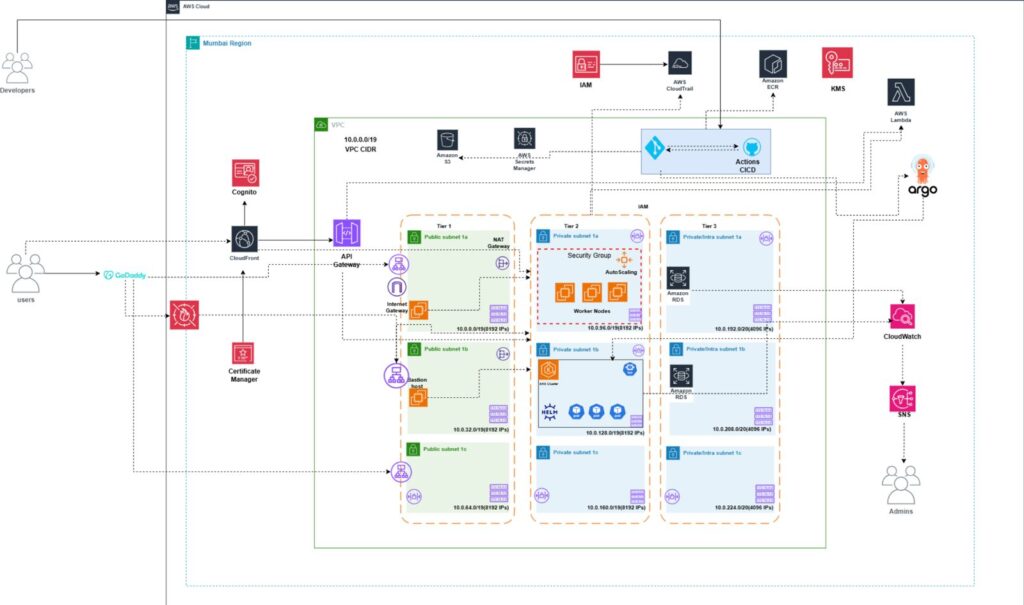
We designed and implemented a Kubernetes-centric AWS architecture for GoodMeetings to support its AI-powered meeting intelligence platform, which processes real-time audio, analytics, and actionable insights at scale. The platform was implemented using Amazon EKS as the primary container orchestration layer, replacing the earlier approach where application services were deployed on isolated EC2 instances per meeting.
The environment was structured within a dedicated VPC using a tiered subnet model. Public subnets handled controlled ingress through CloudFront and API Gateway, while all compute workloads ran in private subnets across multiple Availability Zones. Amazon EKS worker nodes operated behind NAT gateways, ensuring outbound access without exposing workloads publicly. Persistent data layers such as Amazon RDS were isolated in private infrastructure subnets, improving both security posture and fault tolerance.
GoodMeetings’ core services—including meeting ingestion services, AI-driven analytics processors, session orchestration components, backend APIs, and internal management services—were containerized and deployed on EKS. This transition replaced the earlier pattern of provisioning one EC2 instance per meeting, which had caused severe cost inefficiencies and scaling bottlenecks.
Workloads were deployed with replica-based high availability and distributed across Availability Zones to ensure resilience during traffic spikes. Kubernetes scheduling and autoscaling enabled the platform to dynamically allocate compute capacity based on concurrent meetings and processing demand, significantly improving elasticity without overprovisioning infrastructure.
Security improvements were a critical focus for GoodMeetings as part of their SOC 2 readiness journey. IAM roles and policies were redesigned using least-privilege principles, ensuring services accessed only required AWS resources. Sensitive configuration data and credentials were centrally stored in AWS Secrets Manager and encrypted using AWS KMS.
We remediated over 400 cloud security findings within two weeks, addressing misconfigurations across IAM, networking, logging, and encryption controls. AWS CloudTrail was enabled to capture API activity for audit purposes, while security groups and subnet isolation restricted lateral movement across the environment. These measures established a strong compliance-aligned security baseline.
A comprehensive observability stack was implemented to provide end-to-end visibility across infrastructure and applications. Prometheus and Grafana were deployed for Kubernetes and node-level metrics, while Amazon CloudWatch handled application logs, alarms, and service-level monitoring. Fluent Bit was configured to efficiently route logs, significantly reducing log ingestion and storage costs.
Custom dashboards enabled operations teams to monitor meeting load, processing latency, and system health in real time. Proactive alerts were configured using CloudWatch and SNS, allowing rapid incident detection and response while reducing alert noise.
The entire AWS environment—including networking, EKS clusters, node groups, IAM roles, RDS databases, Lambda functions, and monitoring components—was managed using Infrastructure as Code. This ensured repeatable provisioning, environment parity, and audit-friendly change management.
Production environments were protected from manual changes, with all updates flowing through automated pipelines. Kubernetes-native deployment strategies and version-controlled configurations enabled safe rollbacks without service disruption, improving overall platform reliability.
By migrating to an EKS-based, automated DevOps platform, GoodMeetings achieved over 30% reduction in AWS costs in the initial phase, with continued incremental savings through optimized compute utilization and observability tooling. The new architecture doubled platform scalability while eliminating the inefficiencies of per-meeting EC2 provisioning.
Operational effort was significantly reduced as DevOps workflows moved to an automated, self-healing model. The platform now supports rapid growth, improved security posture, and predictable operating costs, enabling GoodMeetings to focus on enhancing its AI-driven meeting insights rather than managing infrastructure complexity.