
In today’s fast-paced digital landscape, ensuring the health and security of applications and infrastructure is critical for businesses. A log monitoring system provides real-time visibility into system performance, security events, and operational issues, enabling teams to proactively address problems. By leveraging DevOps AI tools and modern DevOps technologies, organizations can build robust log monitoring solutions that integrate seamlessly and enhance operational efficiency. This blog will guide you through creating a log monitoring system, exploring its components, tools, and best practices, while incorporating central log management and security logging and monitoring for a comprehensive solution.

Log monitoring refers to the process of collecting, analyzing, and visualizing log data generated by applications, servers, and infrastructure components. Logs are records of events, errors, or activities within a system, often stored in log files. What is system logging? It’s the mechanism by which systems generate these records, which can include basic error logs, transaction details, or security log management data. A log monitoring system ensures that these logs are continuously tracked, providing insights into system health, performance bottlenecks, and potential security threats.
Logs are the backbone of observability in IT systems. They serve multiple purposes:
Without a robust log monitoring system, organizations risk delayed issue detection, prolonged downtimes, and security vulnerabilities.
Building a log monitoring system requires integrating several components to ensure scalability, reliability, and real-time visibility. Here’s a breakdown of the essential elements:
Log collection involves gathering log files from various sources, such as servers, applications, databases, and cloud services. Tools like Fluentd, Logstash, or Filebeat can aggregate logs from distributed systems, ensuring central log management. For cloud-based environments, cloud log management solutions like AWS CloudWatch or Google Cloud Logging are popular choices.
Once collected, logs need to be stored efficiently for analysis. Central log management systems like Elasticsearch or Loki provide scalable storage solutions. These platforms allow you to index logs for quick retrieval and support application log analysis through advanced querying capabilities.
Log file monitoring involves parsing and analyzing logs to extract meaningful insights. Tools like the ELK Stack (Elasticsearch, Logstash, Kibana) or Grafana Loki enable teams to filter, search, and visualize log data. DevOps AI tools can enhance this process by using machine learning to detect anomalies or predict issues based on historical log patterns.
Real-time visibility requires intuitive dashboards and alerting mechanisms. Logging monitoring tools like Kibana, Grafana, or Splunk provide customizable dashboards to visualize log data. Alerts can be configured to notify teams via email, Slack, or PagerDuty when specific thresholds are breached, such as a spike in basic error logs.
For security log management, logs must be analyzed for potential threats, such as repeated failed login attempts or unusual API calls. Server log monitoring software like Splunk or Sumo Logic can integrate with SIEM (Security Information and Event Management) systems to enhance security logging and monitoring.

Here’s a step-by-step guide to creating a log monitoring system that aligns with modern DevOps service company practices and leverages DevOps technologies:
Before selecting log monitoring tools, identify your system’s needs:
For example, a DevOps service company running a CI/CD pipeline with ArgoCD may prioritize monitoring deployment logs to ensure smooth rollouts.
Selecting the right tools logging solutions depends on your infrastructure and budget. Here are some popular log monitoring tools:
When evaluating tools, consider scalability, ease of integration, and support for is it best logging solutions for cloud frontend requirements.
Deploy log collectors like Fluentd or Filebeat on your servers or containers. Configure them to collect logs from relevant sources, such as:
Ensure logs are tagged with metadata (e.g., source, timestamp, environment) for easier application log analysis.
Set up a centralized storage solution like Elasticsearch or Loki. For cloud log management, ensure the storage solution supports high availability and scalability. Configure retention policies to manage storage costs, keeping only the necessary logs for compliance and analysis.
Use logging monitor tools to create dashboards that display key metrics, such as error rates, API response times, or security events. For example:
DevOps AI tools can enhance analysis by automatically identifying patterns or anomalies, reducing manual effort.
For organizations using CI/CD pipeline with ArgoCD, integrate log monitoring into the deployment process. For example:
Implement security logging and monitoring by configuring your log monitoring system to detect and flag suspicious activities. For example:
Regularly test your log monitoring system to ensure it captures all relevant logs and triggers alerts as expected. Optimize log parsing rules to reduce noise and focus on actionable insights. Use application log analysis to identify recurring issues and improve system performance.
Among the many log monitoring tools available, the ELK Stack, Splunk, and Grafana Loki are some of the most popular. The choice depends on your use case:
To maximize the effectiveness of your log monitoring system, follow these best practices:
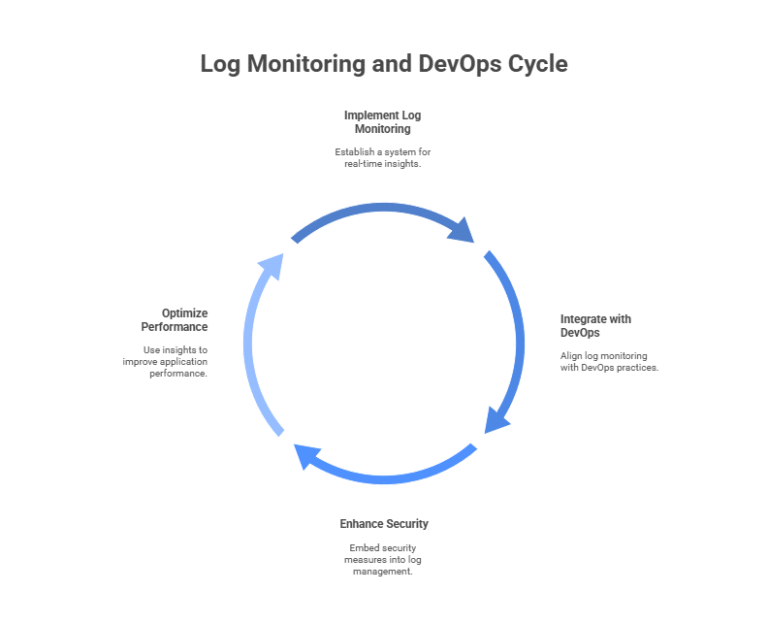
A well-designed log monitoring system is essential for maintaining visibility into your applications and infrastructure. By leveraging DevOps technologies and log monitoring tools, organizations can achieve real-time insights, improve troubleshooting, and enhance security log management. Integrating log monitoring with CI/CD with ArgoCD ensures seamless deployments and operational efficiency. Moreover, embracing DevSecCOps.AI empowers teams to embed security and intelligent analytics into every stage of the development lifecycle, proactively identifying risks and optimizing performance. Whether you’re a DevOps service company or managing a cloud-native application, a log monitoring system powered by DevSecCops.ai is a critical investment for long-term success in today’s dynamic digital environment.