MIGRATION
Move to the Cloud. Without the Downtime.
Seamlessly migrate applications, databases, infrastructure, and CI/CD pipelines from On-Premises, Azure, or GCP to AWS using proven migration frameworks, ensuring minimal downtime, business continuity, and optimized cloud architectures.
Get a Free Cloud Assessment →
MODERNIZATION
Turn Legacy Infrastructure Into a Platform Built to Scale.
Transform legacy applications into scalable cloud-native platforms using Containers, Kubernetes, Microservices, Serverless, CI/CD, GitOps, Infrastructure as Code, and Internal Developer Platforms to accelerate software delivery and innovation
Modernize My Infrastructure →
SECURITY & COMPLIANCE
Build Secure. Stay Compliant. Ship With Confidence.
Secure your cloud environment with Landing Zones, AWS Well-Architected Reviews, Security Assessments, VAPT, IAM Guardrails, Network Security, Infrastructure Hardening, Data Protection, and compliance with ISO 27001, SOC 2, PCI DSS, HIPAA, and CIS Benchmarks.
Get a Security Assessment →
FINOPS
Stop Overpaying for Cloud Infrastructure.
Maximize cloud efficiency by implementing Rightsizing, Auto Scaling, Spot Instances, Storage Optimization, Resource Governance, Cost Visibility, and FinOps best practices, helping reduce infrastructure costs while maintaining performance.
Get My Free Cost Audit →
ENTERPRISE GENERATIVE AI
Turn Enterprise AI Into Real Business Outcomes.
Design and implement secure Enterprise Generative AI solutions using Amazon Bedrock, AI Agents, RAG, Knowledge Bases, MCP, LLMs, Prompt Engineering, AI Governance, and Intelligent Automation to accelerate business transformation
Build My AI Solution →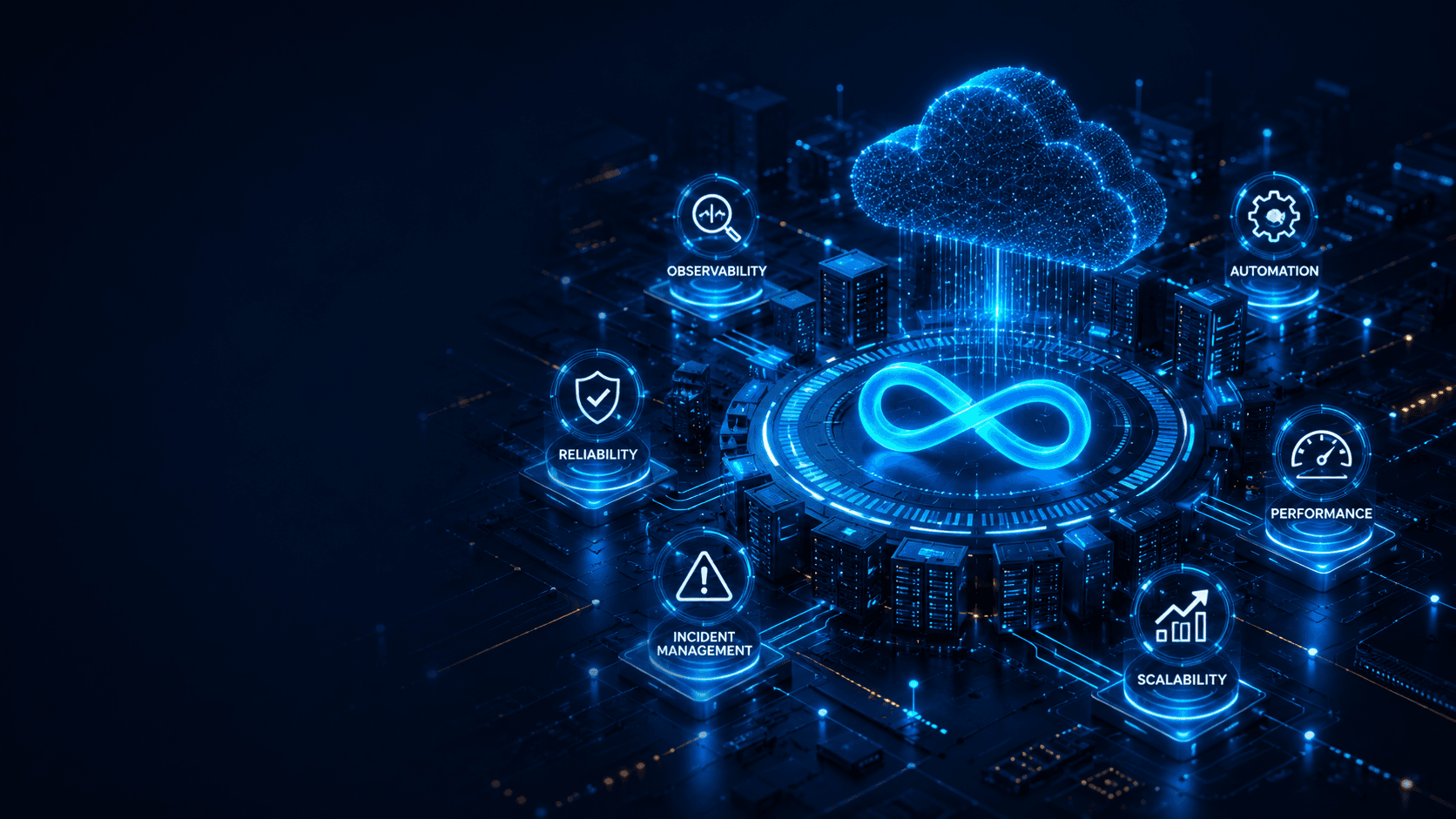
SITE RELIABILITY ENGINEERING
Make Every Production System More Resilient.
Improve platform resilience through Monitoring, Logging, Tracing, SRE best practices, High Availability, Multi-Region Disaster Recovery, Backup & Recovery, Automated Failover, and Business Continuity planning to ensure reliable operations.
Improve My Cloud Reliability →
CLOUD STRATEGY & ADVISORY
Know Where Your Cloud Is Going Before You Spend More.
Accelerate your cloud journey with Cloud Readiness Assessments, Migration Planning, Well-Architected Reviews, Security Reviews, Cloud Adoption Roadmaps, Architecture Design, and Generative AI Use Case Discovery Workshops aligned with AWS best practices.
Talk to a Cloud Architect →
AWS-Certified Experts Delivering Cloud Excellence.
Trusted by Business, Proven by Results.
Meet your autonomous DevSecOps agents.
Traditional tools detect and alert. Our agentic AI perceives threats, reasons through solutions, and responds autonomously — without waiting for a human at every step.
AI Solutions That Solve
Real Business Challenges
Production-ready AI solutions designed around real business needs, workflows, and outcomes.
& Use Cases
PharmaTech — AI WhatsApp Pharmacy Ordering Assistant
An intelligent WhatsApp and Voice AI solution that enables pharmacies to seamlessly place medicine orders with distributors and wholesalers using natural language conversations, reducing manual effort and improving order turnaround time.
EnergyTech — AI Multi-Lingual Electricity Bill Intelligence
Built an advanced image processing system capable of extracting and analyzing electricity bill data across multiple languages. Achieved 92% extraction accuracy while significantly reducing processing latency for faster business operations.
HealthTech — AI Cancer Recovery Assistant
An intelligent healthcare assistant that delivers personalized cancer recovery guidance, AI-driven symptom and side-effect management, and 24×7 patient support using proprietary medical knowledge to improve patient engagement and treatment adherence.
HospitalityTech — AI Hotel Direct Booking & Property Management Platform
A complete hotel management platform with SEOoptimized booking websites, enabling hotels to receive commission-free direct bookings while managing their entire property. Integrated AI-powered WhatsApp and Voice Agents provide automated guest assistance and booking support.
SportsTech — AI Sports Performance Analytics
Developing a next-generation SportsTech platform that leverages computer vision and real-time AI analytics to evaluate football player performance, identify improvement areas, and deliver datadriven coaching insights.
HRTech — AI Recruitment Intelligence Agent
An AI-powered hiring assistant that automates resume screening, candidate-job matching, profile enrichment, and response evaluation, enabling organizations to make faster, smarter, and more accurate recruitment decisions.
PropTech — AI Property Valuation Platform
An AI-driven property intelligence platform that analyzes amenities, locality, comparable sales, demand signals, and listing data to generate real-time fair-market valuations, helping acquisition teams identify undervalued opportunities and make data-driven property decisions with confidence.
MediaTech — AI Live Transcription Platform
An AI-driven MediaTech solution that performs real-time speech-to-text transcription from live video streams, enabling broadcasters and media organizations to generate instant captions, searchable transcripts, multilingual subtitles, and live content insights with high accuracy and low latency.
Comprehensive cloud
solutions that scale.
Six core disciplines, one unified delivery model — built for teams that can't afford downtime.
Migration
Seamless cloud migration across AWS, Azure, and Google Cloud with zero downtime, automated workflows, and optimized cost-performance management.
Trusted by forward-thinking teams



DevSecCops.ai helped us build a highly scalable and reliable Kubernetes platform with remarkable speed. Their automation reduced execution time by 50%, strengthened our security, and positioned us for significant infrastructure cost savings. The platform has enabled our team to scale efficiently without expanding our DevOps headcount
Vaibhav Dhage
Lead Architect
10x faster deployments
Ready to build
something great?
Join 20+ teams shipping faster with DevSecCops.ai. Start with a free cloud + cost audit