
We designed and supported a highly available application architecture deployed within a dedicated Amazon VPC in the ap-south-1 (Mumbai) region. The environment follows a multi-tier network design with clearly separated public and private subnets distributed across multiple Availability Zones to support fault tolerance, scalability, and security. End-user traffic is routed through Akamai, where edge-level protections such as TLS termination and web application firewall (WAF) are applied. Requests are then forwarded to Amazon CloudFront, which provides content delivery and caching before traffic enters the AWS environment through an Internet Gateway. Within the VPC, traffic is distributed using an Application Load Balancer (ALB) deployed in public subnets. The ALB routes requests to application components hosted in privatesubnets, ensuring that backend workloads are not directly exposed to the internet.
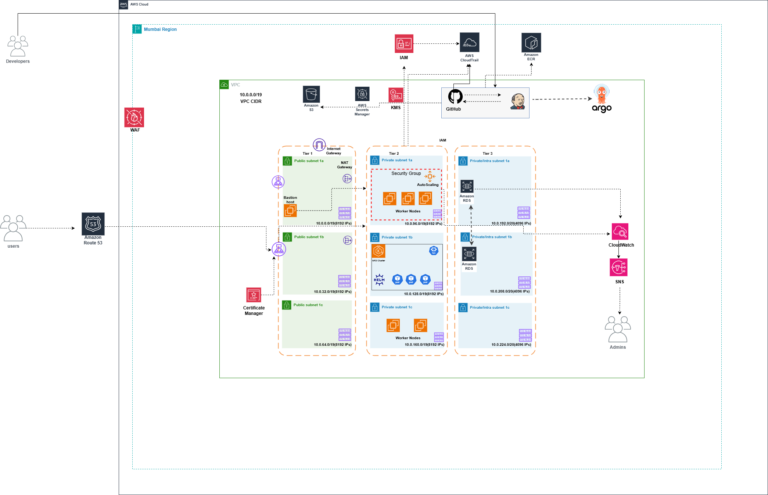
Application components are deployed across multiple Availability Zones within private subnets and are grouped into frontend and backend server tiers. These compute layers are configured with Auto Scaling Groups, allowing capacity to be adjusted based on operational requirements.
Internal service-to-service communication is handled using internal load balancing, enabling controlled traffic flow between frontend and backend components. Outbound internet access from private workloads is provided through NAT Gateways deployed in public subnets.
The architecture integrates Amazon EKS to support containerized workloads where applicable. Kubernetes is used to manage container lifecycle, pod placement, and internal service communication. EKS clusters are deployed in private subnets to ensure that containerized workloads remain isolated from direct internet access. Container images are stored in Amazon Elastic Container Registry (ECR) and deployed through automated pipelines.
Backend data services are deployed in dedicated private subnets to maintain isolation from
application and internet-facing tiers.
● Amazon RDS for MySQL is used for relational database workloads.
● Amazon ElastiCache (Redis) is used to support in-memory caching and low-latency data access.
● Amazon S3 is used for object storage and application artifacts.
Network access to database and cache layers is restricted using security groups and
subnet-level routing to ensure only authorized application components can communicate
with these services.
Source code is maintained in GitHub, with GitHub Actions used to automate build workflows. Container images are built and pushed to Amazon ECR as part of the CI pipeline. Argo CD is used to manage application deployments, enabling declarative and controlled rollout of changes. Application configuration values are stored in AWS Systems Manager Parameter Store, allowing secure retrieval of configuration data at runtime.
Security controls are implemented across multiple layers:
● AWS Key Management Service (KMS) is used to manage encryption keys for supported services.
● AWS Secrets Manager is used to securely store and manage sensitive credentials.
● AWS GuardDuty and AWS Security Hub are enabled to support threat detection and security posture monitoring.
● AWS IAM is used to enforce least-privilege access across services and deployment pipelines.
The architecture includes AWS Lambda functions and Amazon SQS to support asynchronous processing and event-driven workflows. These services are integrated with application components to handle background tasks and decouple processing where required.
Operational visibility is provided using Amazon CloudWatch, which is used to collect metrics, logs, and alarms across application, database, and infrastructure components. Logs from services such as ALB, RDS, MongoDB, and EC2 are centralized to support troubleshooting and operational monitoring.
Amazon SNS is integrated to deliver notifications and alerts for operational events.
The VPC is segmented into:
● Public subnets hosting ALBs and NAT Gateways
● Private subnets hosting application compute, EKS clusters, and backend services
This design enforces controlled ingress and egress while maintaining strong isolation between application and data layers. Administrative access is restricted and managed through controlled access paths.
Infrastructure components including VPC networking, compute resources, EKS clusters, IAM roles, and supporting services are provisioned using infrastructure-as-code practices to ensure consistency and repeatability.
CI/CD pipelines automate application build and deployment workflows, reducing manualintervention and enabling controlled, auditable releases. Rollback mechanisms are supported through versioned deployments and load balancer–based traffic routing.
This architecture enables the client to operate a scalable and secure application platform with clear separation between edge, application, and data layers. The DevOps practices implemented support reliable deployments, secure configuration management, and improved operational visibility while aligning with AWS architectural and security best practices.
The solution provides a flexible foundation that can evolve with application requirements
while maintaining operational control and security.