Enterprise software delivery has changed dramatically. According to Gartner, by 2026 more than 80% of enterprises will have integrated AI-driven automation into their software delivery pipelines — up from less than 20% in 2022. The pressure is real: faster release cycles, growing security threats, and complex cloud-native infrastructures have made traditional DevOps practices insufficient.
AI tools for DevOps pipeline management are no longer optional add-ons. They are strategic infrastructure. Teams using AI-driven CI/CD and intelligent DevOps monitoring report up to 45% faster deployment cycles and a 60% reduction in mean time to resolution (MTTR), per the 2025 DORA State of DevOps Report.
This guide is designed for engineering leaders, platform architects, and DevSecOps teams evaluating enterprise DevOps automation platforms. You will learn what to look for, what to avoid, and how to make AI adoption practical and scalable.
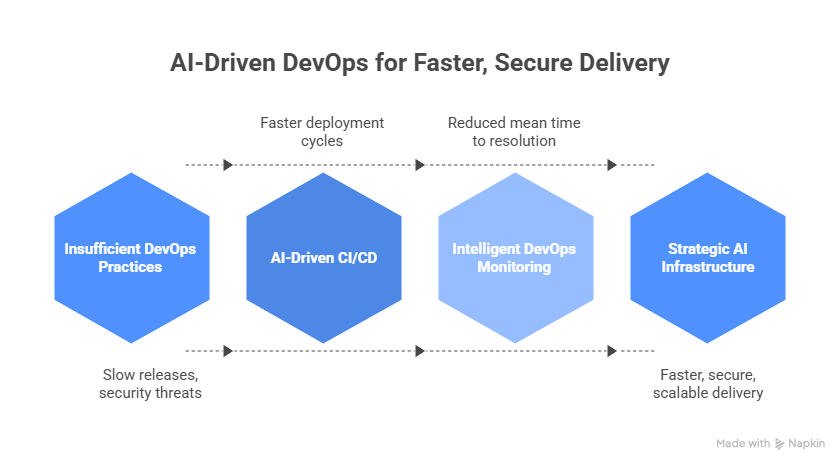
Before evaluating AI solutions, it helps to name the exact pain points that are slowing enterprises down today.
Manual bottlenecks in CI/CD pipelines. Even with Jenkins or GitLab CI, most teams still rely on human judgment for release approvals, environment provisioning, and incident triage — all of which create delays and inconsistency.
Alert fatigue and monitoring noise. Operations teams running large microservices architectures receive thousands of alerts daily. Without AI-based filtering and correlation, signal gets lost in noise.
Reactive security posture. Traditional DevOps teams detect vulnerabilities after deployment. Shifting security left requires automation that most legacy toolchains do not support natively.
Slow incident response. Without predictive DevOps analytics, root cause analysis is manual, time-consuming, and often based on guesswork rather than data.
Lack of unified observability. Disparate tools for logging, tracing, and metrics create visibility gaps. Cloud-native DevOps tools need to integrate these into a single pane of glass.
Not every AI DevOps platform is built for enterprise scale. Before purchasing or piloting any solution, validate it against this checklist:
Seamless integration with existing CI/CD tools (Jenkins, GitHub Actions, GitLab, Azure DevOps). Role-based access control (RBAC) and audit logging for compliance. Support for on-premise, hybrid cloud, and multi-cloud deployments. SOC 2 Type II, ISO 27001, or FedRAMP certification for secure AI DevOps tools. Explainable AI outputs — decisions must be auditable, not black-box. Real-time and historical analytics dashboards for predictive DevOps analytics. API-first architecture enabling custom integrations and extensibility. SLA-backed uptime guarantees (99.9%+) and enterprise-grade support. Vendor lock-in avoidance — open standards and portable configurations. Proven ROI benchmarks — the vendor should provide customer case studies.
Enterprise DevOps AI platforms typically address five key functional areas. Understanding each category will help you assemble the right stack — or choose a platform that covers multiple layers.
4.1 Intelligent DevOps Monitoring
AI-driven monitoring tools go beyond threshold alerts. They use anomaly detection, time-series analysis, and machine learning to distinguish genuine incidents from noise. Platforms like Dynatrace Davis AI and New Relic AI correlate events across distributed systems and surface probable root causes in seconds, not hours. Enterprises using intelligent monitoring report a 40% reduction in false-positive alerts, according to Forrester Research.
4.2 AI-Driven CI/CD
AI in release management transforms static pipelines into adaptive systems. Tools such as Harness AI and LinearB analyze historical build data to predict test failures, prioritize flaky tests, and recommend optimal deployment windows. The result: fewer rollbacks, faster delivery, and data-backed release confidence. Teams using AI-driven CI/CD cut failed deployments by up to 35%, per the 2025 GitLab DevSecOps Survey.
4.3 DevOps Security Automation
DevOps security automation — often called DevSecOps — embeds security testing directly into the pipeline. Automated code quality scanning tools like Snyk, Checkmarx, and SonarQube with AI plugins detect vulnerabilities at the code, dependency, and container image level before they reach production. These tools reduce the cost of fixing a security flaw by up to 85% when caught at the development stage versus post-deployment, per IBM Security Cost of a Data Breach Report 2024.
4.4 AI-Powered Observability
Observability platforms combine metrics, logs, and traces into a unified context. AI layers on top of that context to surface insights humans would miss. Cloud-native DevOps tools like Honeycomb and Elastic Observability use predictive analytics to identify degradation trends before they become outages — a capability that traditional monitoring tools simply cannot replicate.
4.5 AI-Augmented Testing
AI testing tools like Testim, Mabl, and Applitools use visual AI and self-healing test automation to reduce test maintenance overhead — a significant cost for enterprise QA teams. These platforms also generate test cases from user behavior data, improving coverage without proportional manual effort.
Integration is where many enterprise AI initiatives stall. The key is a phased adoption model that minimizes disruption while delivering measurable value quickly.
Phase 1 — Audit and Baseline (Weeks 1–4). Map your current pipeline stages. Identify manual handoffs, recurring failure points, and monitoring gaps. Establish baseline KPIs: deployment frequency, lead time, MTTR, and change failure rate.
Phase 2 — Pilot on Non-Critical Workloads (Weeks 5–10). Deploy your chosen AI DevOps platform on a low-risk service or team. Focus on monitoring and observability first — these yield fast, visible ROI with minimal pipeline disruption.
Phase 3 — Expand to CI/CD (Weeks 11–20). Integrate AI-driven CI/CD capabilities. Enable automated test prioritization, deployment risk scoring, and rollback recommendations. Validate against your Phase 1 baseline.
Phase 4 — Embed Security Automation (Weeks 21–30). Add DevOps security automation across all active pipelines. Define security gates that auto-pass clean builds and flag vulnerabilities for human review rather than blocking all deployments.
Phase 5 — Operationalize and Optimize (Ongoing). Build internal runbooks around AI recommendations. Train teams to trust — and verify — AI-generated insights. Continuously tune models using your organization’s own incident history.
Enterprise AI DevOps platforms vary widely in pricing model, scalability architecture, and security posture. Here is what to evaluate before signing a contract.
Cost: Most enterprise DevOps AI platforms price on a per-seat, per-pipeline, or consumption-based model. Consumption-based pricing can scale unpredictably in large organizations. Negotiate a cap or commit pricing if you anticipate high usage volume. Always calculate the total cost of ownership (TCO) including integration engineering time, training, and ongoing tuning — not just the subscription fee.
Scalability: Validate that the platform has been tested at your anticipated scale. Request case studies from companies with similar pipeline complexity and deployment frequency. Enterprise DevOps automation platforms should support horizontal scaling, multi-region deployment, and handle concurrent pipeline execution without degradation.
Security: Secure AI DevOps tools must meet your data residency requirements. If your organization operates in regulated industries — finance, healthcare, government — verify that the vendor offers dedicated tenancy, data encryption at rest and in transit, and compliance with GDPR, HIPAA, or FedRAMP as applicable. Always review the vendor’s shared responsibility model.
Even experienced engineering organizations make avoidable mistakes during AI DevOps tool selection. These are the most common — and most costly.
Choosing breadth over fit. Platforms that promise to do everything often do nothing exceptionally well. Choose tools that solve your top two or three pain points deeply rather than covering all categories superficially.
Ignoring change management. AI tool adoption fails when engineers feel replaced rather than augmented. Invest in training, create feedback loops, and communicate clearly that AI assists human judgment — it does not replace it.
Skipping proof-of-concept (PoC) validation. Vendor demos are optimized for success. Always run a time-boxed PoC on real workloads with real constraints before committing.
Underestimating integration complexity. AI DevOps platforms that do not have native connectors for your existing toolchain will require significant custom engineering. Budget for integration time explicitly.
Treating AI as a set-and-forget solution. AI models drift as codebases and infrastructure evolve. Plan for quarterly model reviews and retraining to maintain accuracy and relevance.
The next four years will bring a fundamental shift in how AI operates within DevOps — moving from assistive to autonomous, and from reactive to predictive.
Autonomous pipelines will emerge as the dominant model by 2028. Gartner predicts that by 2028, agentic AI will autonomously handle over 30% of software release decisions without human intervention in early-adopter enterprises. These systems will self-heal failing builds, reroute deployments around failing infrastructure, and auto-remediate security vulnerabilities with verified patches.
Predictive DevOps analytics will move from anomaly detection to full incident prevention. Models trained on years of pipeline telemetry will predict failures days in advance, giving platform teams time to act proactively. This shift will reduce unplanned downtime costs which IDC estimates at $400,000 per hour for large enterprises dramatically.
AI in release management will evolve to include business context awareness. Future systems will factor in customer impact, revenue risk, and compliance exposure when scoring deployment readiness not just technical metrics. Security will become fully embedded, with AI performing real-time threat modeling as code is written, rather than scanning finished artifacts.
Finally, the convergence of DevOps, security, and compliance into unified AI-driven platforms — what is increasingly called DevSecOps automation — will make fragmented point solutions obsolete for enterprises operating at scale.
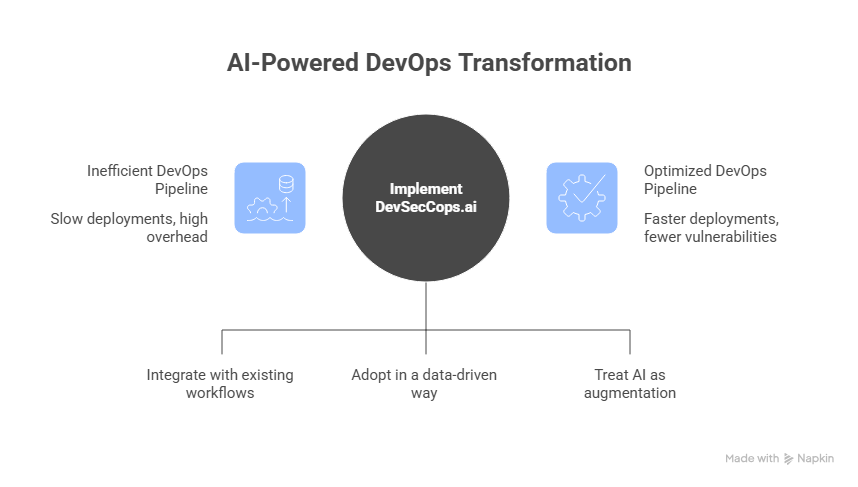
Choosing the right AI tools for your DevOps pipeline is one of the highest-leverage decisions an enterprise engineering organization can make in 2026. The difference between teams that get it right and those that struggle comes down to three factors: selecting tools that integrate deeply with existing workflows, adopting in a phased and data-driven way, and treating AI as an augmentation layer rather than a replacement for engineering judgment.
The categories that deliver the fastest and most measurable ROI — intelligent DevOps monitoring, AI-driven CI/CD, and DevOps security automation — should anchor your evaluation process. Everything else should complement those foundations.
If you are ready to move from evaluation to execution, DevSecCops.ai is the platform built for exactly this challenge. As a purpose-built AI-driven DevSecOps automation platform for enterprises, DevSecCops.ai unifies monitoring, security, and release intelligence into a single, enterprise-grade platform. It integrates natively with your existing toolchain, meets the compliance standards your regulated industry demands, and delivers measurable outcomes faster deployments, fewer vulnerabilities, and lower operational overhead from day one.
Schedule a personalized enterprise demo at DevSecCops.ai and see how AI-driven DevSecOps can transform your pipeline in 90 days or less.
Devseccops is proudly powered by WordPress