In 2025, DevOps technologies are transforming software delivery by enabling faster, more reliable, and secure pipelines. DevOps AI tools, powered by AI in DevOps, are driving this evolution, automating complex tasks and enhancing observability. A DevOps service company leverages these tools to empower businesses, such as a tech startup launching a cloud-native application, to achieve operational agility. This blog explores nine cutting-edge DevOps AI tools that are shaping DevOps technologies, focusing on CI/CD pipeline with ArgoCD, AI DevOps platforms, log monitoring system, and DevOps machine learning, and how they enable scalability, compliance, and efficiency.

AI in DevOps is redefining DevOps technologies by integrating DevOps machine learning to predict issues, automate workflows, and optimize resources. DevOps AI tools enhance collaboration, security, and scalability, addressing modern challenges like real-time monitoring and compliance. A DevOps service company uses AI for DevOps to help startups scale rapidly. For a tech startup launching dwa cloud-native application, using AI in DevOps ensures seamless deployments and cost efficiency, positioning DevOps and AI as critical drivers of innovation in 2025.
GitHub Copilot, a leading DevOps AI tool, leverages AI in DevOps to provide real-time code suggestions, boosting developer productivity within DevOps technologies. By analyzing codebases, it reduces errors and accelerates coding by 30%. For a startup, Copilot integrates with CI/CD pipeline with ArgoCD, streamlining code commits for faster iterations. A DevOps service company uses Copilot to enhance developer workflows, making it a cornerstone of AI tools for deployment in 2025, ensuring rapid and error-free code delivery.
Dynatrace, a robust log monitoring system, enhances DevOps technologies with AIOps for DevOps, using its Davis AI engine for anomaly detection and root cause analysis. It provides real-time insights into microservices, reducing incident resolution time by 40%. For a startup, Dynatrace ensures uptime during traffic surges, integrating with Kubernetes environments. A DevOps service company leverages Dynatrace to deliver observability, critical for maintaining reliability in cloud-native applications in 2025.
Harness, an AI DevOps platform, transforms DevOps technologies by automating CI/CD pipeline with ArgoCD workflows. Its DevOps machine learning capabilities predict pipeline failures and optimize resources, cutting deployment times by 25%. A DevOps service company uses Harness to streamline a startup’s release cycles, ensuring compliance with security standards. By integrating AI for DevOps, Harness supports continuous deployment, making it a vital AI tool for deployment in 2025.
Datadog, a leading log monitoring system, powers DevOps technologies with AIOps for DevOps, using unsupervised machine learning to detect anomalies in real time. Its Watchdog feature correlates logs and metrics, speeding up root cause analysis by 50%. For a startup, Datadog integrates with over 600 DevOps technologies, providing unified observability. A DevOps service company uses Datadog to ensure system reliability, enabling startups to handle high-availability workloads in 2025.
Snyk, a standout DevOps AI tool, strengthens DevOps technologies by scanning codebases for vulnerabilities, using AI to prioritize critical fixes and reduce risks by 35%. Integrated with CI/CD pipeline with ArgoCD, Snyk automates security checks for startups. A DevOps service company employs Snyk to ensure compliance with regulations like GDPR, leveraging using AI in DevOps to protect cloud-native applications from threats in 2025, enhancing trust and security.
PagerDuty enhances DevOps technologies with DevOps AI tools for incident management. Its Event Intelligence module uses machine learning to group alerts and route incidents, reducing downtime by 20%. For a startup, PagerDuty integrates with a log monitoring system like Datadog, ensuring rapid resolution. A DevOps service company leverages PagerDuty to maintain service reliability, demonstrating how to use AI in DevOps to improve user retention in competitive markets.
Kubiya, an innovative DevOps AI tool, acts as a virtual assistant for DevOps technologies, using natural language processing to automate workflows and troubleshoot issues. It saves 15% of developer time by provisioning infrastructure and resolving queries. For a startup, Kubiya integrates with an AI DevOps platform, streamlining resource allocation. An AI DevOps engineer can use Kubiya to foster collaboration, enhancing efficiency in 2025 workflows.
Azure DevOps, an AI DevOps platform, enhances DevOps technologies with AI-driven features for CI/CD and testing. Its machine learning predicts deployment risks, improving test coverage by 30%. For a startup, Azure DevOps integrates with CI/CD pipeline with ArgoCD for seamless multi-cloud deployments. A DevOps service company uses Azure DevOps to optimize infrastructure, supporting scalability and compliance in 2025, showcasing AI in DevOps for robust delivery pipelines.
Spacelift, a specialized DevOps AI tool, focuses on infrastructure management within DevOps technologies. Its Saturnhead AI assistant analyzes logs and provides actionable feedback, reducing errors by 25%. For a startup, Spacelift enhances CI/CD pipeline with ArgoCD by automating Terraform workflows. A DevOps service company uses Spacelift to manage multi-cloud environments, ensuring cost optimization and scalability in 2025.
Some speculate whether AI replace DevOps, but DevOps AI tools complement rather than replace human expertise. An AI DevOps engineer uses tools like Kubiya and Harness to augment decision-making, not eliminate roles. DevOps and AI work synergistically, with AI handling repetitive tasks and humans focusing on strategy, ensuring DevOps technologies remain human-driven in 2025.

These DevOps AI tools revolutionize DevOps technologies by addressing key challenges:
For a tech startup, these tools enable rapid launches, cost savings, and compliance with standards like RBI’s IPv6, driving 3x faster scaling through AI tools for deployment.
To leverage DevOps AI tools effectively in 2025, businesses should follow these best practices:
These practices enable a DevOps service company to implement DevOps technologies effectively, driving innovation.
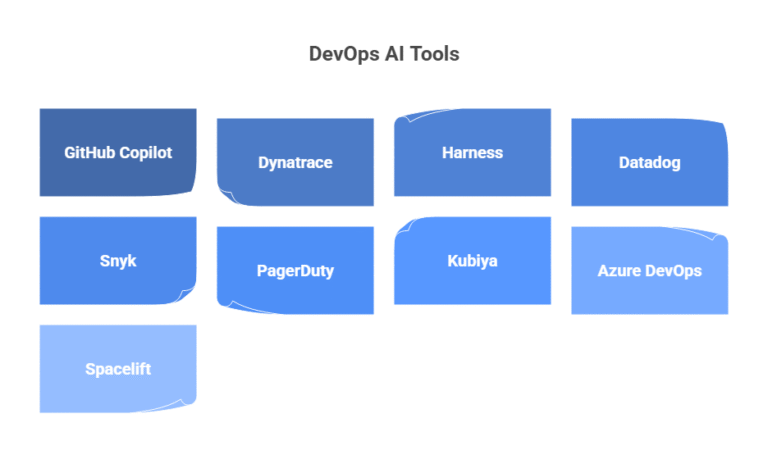
The nine DevOps AI tools—GitHub Copilot, Dynatrace, Harness, Datadog, Snyk, PagerDuty, Kubiya, Azure DevOps, and Spacelift—are powering DevOps technologies in 2025. By leveraging CI/CD pipeline with ArgoCD, AI DevOps platforms, and log monitoring systems, they enable startups to scale rapidly and ensure reliability. A DevOps service company like DevSecCops.ai harnesses AI in DevOps to deliver tailored solutions. Contact DevSecCops.ai at to explore how DevOps AI tools can transform your business.